
An AGV charging station is not just a place where an automated guided vehicle parks to recharge. For industrial automation projects, the charging station directly affects fleet uptime, battery size, maintenance cost, safety, and workflow efficiency.
The most common AGV charging station options include manual plug-in charging, contact-based docking, wireless charging, and battery swapping. For modern factories and warehouses, the main decision is often between contact-based docking and wireless charging. Contact-based docking can be cost-effective and simple, but wireless charging removes exposed charging contacts and can reduce connector wear, cleaning, sparks, and mechanical maintenance.
For AGVs that operate in dusty warehouses, humid environments, cleanrooms, automated production lines, or 24/7 logistics workflows, wireless charging can make the charging process more reliable and easier to automate.

What Is an AGV Charging Station?
An AGV charging station is a fixed charging location where an automated guided vehicle receives power for its battery system. Depending on the design, the AGV may charge manually, automatically through metal contacts, wirelessly through inductive power transfer, or by exchanging batteries.
A charging station usually includes the below components.
| Component | Function |
|---|---|
| Power input | Supplies AC or DC power to the charging station |
| Charging controller | Manages charging output, safety, and communication |
| Charging interface | Plug, contact plate, charging brush, wireless transmitter pad, or battery swap mechanism |
| Vehicle-side interface | Connector, contact pad, receiver coil, or battery tray |
| Battery/BMS connection | Controls safe charging of the AGV battery |
| Safety system | Protects against overcurrent, overvoltage, overheating, misalignment, or fault conditions |
| Communication interface | Optional signals between charger, AGV controller, BMS, or fleet software |
The right design depends on how the AGV works in the facility. A small AGV that charges after each shift may not need the same charging station as a high-utilization vehicle that runs continuously across multiple shifts.
Main Types of AGV Charging Stations
1. Manual Plug-In Charging
Manual plug-in charging is the simplest method. An operator connects a cable to the AGV when charging is needed.
This can work for small fleets or low-use vehicles, but it is not ideal for fully automated operations. Manual charging requires labor, creates cable handling issues, and may cause inconsistent charging behavior if operators forget to charge the vehicle on time.
Best for:
- Small AGV fleets
- Low-duty-cycle vehicles
- Budget-sensitive projects
- Non-24/7 operations
Not ideal for:
- Fully automated warehouses
- Multi-shift production lines
- Sealed robot designs
- High-traffic facilities
- Operations where labor reduction is important
2. Contact-Based Docking
Contact-based docking uses physical metal contacts, charging brushes, or conductive pads. The AGV drives into a charging position, and the vehicle-side contact touches the station-side contact to start charging.
This is a common automated charging method because it is easier to understand and can be less expensive than wireless charging. However, it depends on clean and reliable physical contact.
Contact-based docking can have problems when:
- The AGV does not align accurately
- Contacts become dirty, oily, or oxidized
- Contacts wear down over repeated docking cycles
- The environment has dust, water, or vibration
- Exposed contacts create safety or cleaning concerns
- Docking impact damages the charging interface
3. Wireless Charging Station
BUY 1.5KW WIRELESS CHARGER BUY 3KW WIRELESS CHARGERA wireless AGV charging station uses a transmitter pad or coil on the station side and a receiver coil on the vehicle side. When the AGV reaches the charging position, power transfers across an air gap without exposed metal charging contacts.
This type of system is usually used when automation reliability, low maintenance, sealed design, and charging convenience are important.
Wireless charging is especially useful for:
- AGVs in dusty or humid environments
- Cleanrooms and semiconductor-related applications
- Warehouses with high robot utilization
- Automated production lines
- AGVs that need opportunity charging
- Systems where exposed contacts are undesirable
- Fleets that need lower maintenance over time
For a broader explanation of industrial contactless charging, see ONEPOINTECH’s guide to industrial wireless charging.
4. Battery Swapping
Battery swapping replaces the discharged AGV battery with a charged battery. This can reduce waiting time, but it adds mechanical complexity, spare battery inventory, charging racks, and maintenance.
Battery swapping may be useful for very heavy-duty operations, but it is not always the most efficient solution for modern lithium-battery AGV fleets.
Wireless vs Contact-Based AGV Docking
The most important comparison is not simply “which one is cheaper.” The better question is:
Which charging method gives the best balance of uptime, maintenance, safety, integration difficulty, and long-term operating cost?
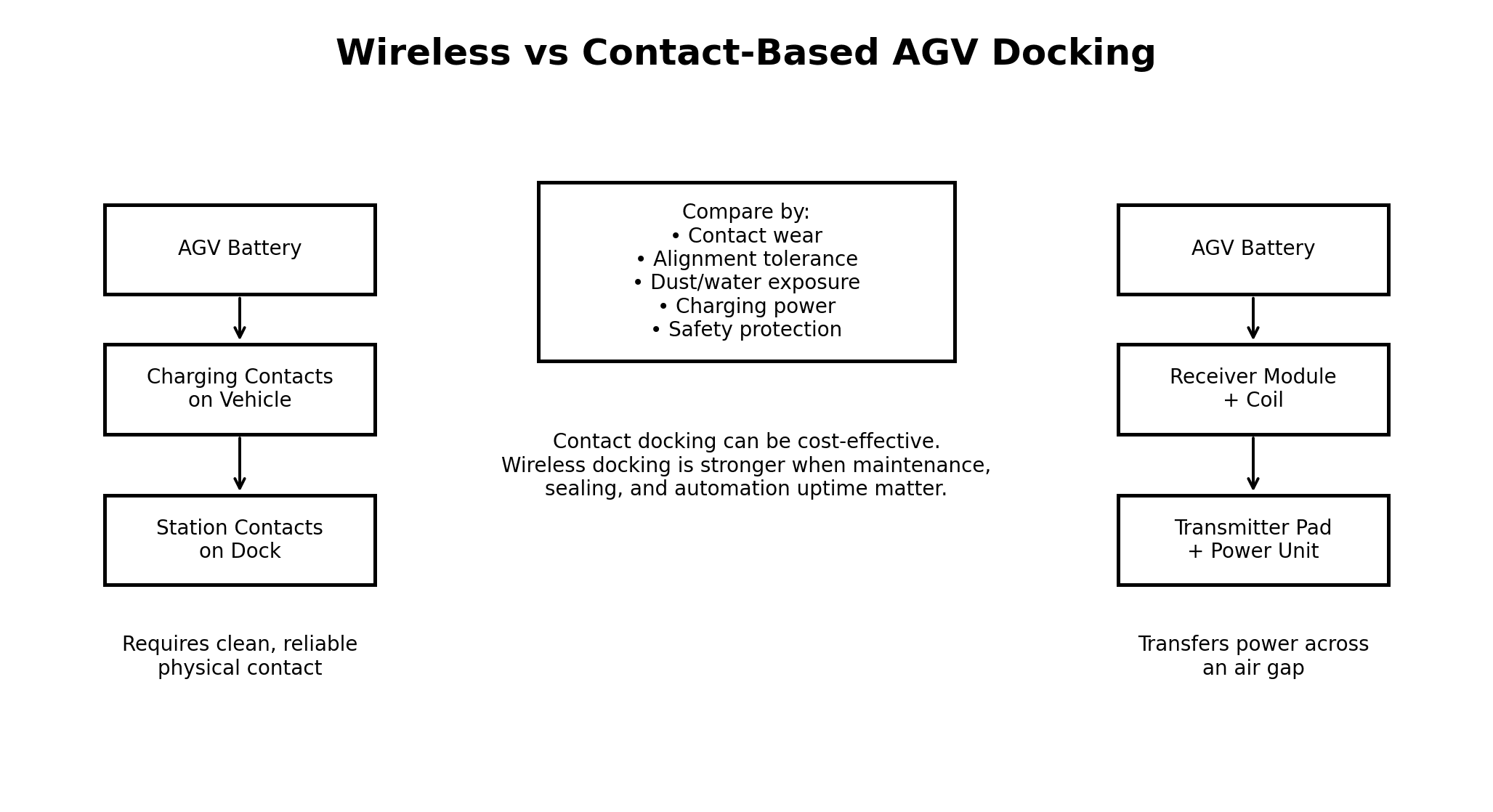
| Factor | Contact-Based Docking | Wireless Charging Station |
|---|---|---|
| Charging interface | Metal contacts, brushes, or conductive pads | Transmitter and receiver coils |
| Physical wear | Contacts can wear over time | No exposed charging contact |
| Dirt and oxidation | Can affect charging reliability | Better for sealed or dirty environments |
| Alignment requirement | Needs reliable mechanical contact | Needs coil alignment within tolerance |
| Maintenance | Cleaning and contact replacement may be needed | Lower mechanical maintenance |
| Spark/arcing risk | Depends on contact design and protection | No direct exposed contact during normal charging |
| Installation cost | Often lower initially | Often higher initially |
| Long-term value | Good for clean, simple systems | Strong for high-utilization or harsh environments |
| Best use case | Controlled environments with accurate docking | Automated fleets where uptime and low maintenance matter |
Wireless charging is not automatically better in every case. Contact-based docking can be a good choice when the environment is clean, the docking position is stable, and the project has strict cost limits.
Wireless charging becomes more attractive when the AGV fleet must operate with fewer interruptions, less cleaning, and fewer mechanical contact failures.
Why Charging Station Design Matters for AGV Uptime
The charging station controls how often and how easily the AGV can return to operation. Poor charging station design can create downtime even when the AGV itself is well designed.
Common charging-related downtime causes include:
- AGV cannot align with the charger
- Contact pads are dirty or worn
- Charging speed is too slow for the workflow
- Battery is too small for the duty cycle
- Charging station is installed in the wrong location
- The fleet has too few chargers
- Charging is not coordinated with task scheduling
- The charger cannot communicate status to the AGV or fleet system
- Heat causes charging current to reduce
- The charging interface is damaged by repeated docking
A good charging station should be designed around the AGV’s actual workflow, not just the battery specification.
Key Design Factors for an AGV Charging Station
1. Battery Voltage
The charging station must match the AGV battery system. Common AGV batteries may use 24V, 36V, or 48V, but industrial vehicles can use other voltages.
Before selecting a charger, prepare:
- Nominal battery voltage
- Maximum battery voltage
- Battery chemistry
- BMS requirements
- Maximum charging current
- Required charging profile
For wireless charging projects, the receiver output must be designed to work safely with the battery or BMS.
2. Battery Capacity and Charge Time
Battery capacity affects how much energy the AGV needs. A larger battery usually needs a higher charging power or a longer charging time.
A charging station should be selected based on:
- Battery capacity
- Energy used per hour
- Available charging window
- Number of shifts per day
- Required fleet availability
- Battery charging current limit
- Safety and thermal limits
Do not choose charging power only by guessing. The power level should support the real duty cycle.
3. Charging Power
Charging power determines how quickly the AGV can recover energy. For small AGVs, a lower-power charger may be enough. For heavy AGVs, forklifts, tuggers, or high-utilization vehicles, higher charging power may be required.
Typical questions engineers should ask:
- How many watt-hours does the AGV use per mission?
- How many charging stops are available per shift?
- How long can the AGV stay at each charging point?
- Does the charger need to support opportunity charging?
- Can the battery safely accept the target charging current?
- Is there enough space for the charger, receiver, coil, and thermal design?
Wireless charging products in the market are often designed around opportunity charging and industrial uptime.
4. Docking Accuracy and Alignment Tolerance
Docking accuracy is one of the most important design factors.
For contact-based docking, the AGV must make reliable physical contact. For wireless charging, the transmitter and receiver coils must align within the designed tolerance.
Poor alignment can cause:
- Lower charging efficiency
- Slower charging
- More heat
- Charging failure
- Mechanical wear in contact systems
- Repeated docking attempts
- Fleet delays
For wireless charging, the coil size, coil shape, air gap, and control system determine the usable alignment tolerance. If the AGV cannot park accurately, the charging station may need a physical guide, larger target zone, or a custom coil design.
5. Air Gap
For wireless AGV charging, air gap means the distance between the transmitter coil and receiver coil. The air gap can be affected by:
- Ground clearance
- Floor flatness
- Tire or wheel wear
- Receiver mounting position
- Charging pad height
- Docking structure
- AGV load condition
A larger air gap may reduce efficiency or require a different coil design. If the AGV has changing ground clearance or uneven floor conditions, this must be considered early.
For 200w wireless charging product, check this long-distance 200W industrial wireless charging solution.
6. Mounting Method
AGV charging stations can be designed in several ways:
| Mounting Method | Best For | Notes |
|---|---|---|
| Floor-mounted wireless pad | Low-clearance or bottom receiver designs | Common for contactless charging |
| Wall-mounted transmitter | Side receiver designs | Useful when floor space is limited |
| Docking bay | Controlled parking and alignment | Can improve repeatability |
| Flush floor installation | Smooth traffic areas | Requires more installation planning |
| Above-ground station | Easy retrofit | May need protection from impact |
| Contact rail or plate | Conductive docking systems | Needs reliable contact and cleaning |
7. Communication with AGV or BMS
A simple charger may only provide power. A more advanced charging station may communicate with the AGV controller, fleet management software, or battery management system.
Communication can support:
- Charging start/stop command
- Battery voltage and current monitoring
- Charging status
- Error reporting
- Over-temperature warning
- Misalignment warning
- Fleet scheduling
- Preventing charging outside safe battery limits
Common communication options may include CAN, RS485, UART, GPIO, or supplier-specific protocols.
8. Safety Protection
An AGV charging station should include safety features based on the charging method and operating environment.
For contact-based charging, consider:
- Contact protection
- Anti-spark design
- Overcurrent protection
- Short-circuit protection
- Mechanical shielding
- Emergency stop integration
- Safe contact voltage strategy
For wireless charging, consider:
- Receiver detection
- Foreign object detection
- Over-temperature protection
- Overvoltage protection
- Overcurrent protection
- Misalignment handling
- EMC design
- Automatic shutdown during faults
AGV Charging Station Design Flow
A good AGV charging station project should follow a structured design flow.
[Insert Image 3: AGV charging station design flow]
Step 1: Define the AGV Battery System
Start with the battery, not the charger. Confirm voltage, capacity, chemistry, maximum charging current, BMS requirements, and connector or receiver interface.
Step 2: Calculate Charging Power
Estimate how much energy the AGV consumes per hour and how much time it has available to charge. This determines whether the project needs low-power charging, high-power charging, or opportunity charging.
Step 3: Choose the Charging Method
Compare manual plug-in, contact docking, wireless charging, and battery swapping. Choose based on automation level, environment, downtime cost, maintenance, and budget.
Step 4: Design the Docking Position
Decide whether the station should be installed on the floor, wall, side dock, parking area, loading point, or route stop. The location should support natural workflow instead of forcing the AGV to leave its route too often.
Step 5: Confirm Safety and Communication
Specify protection features, certification requirements, control signals, and communication protocol before ordering samples.
Step 6: Test in Real Floor Conditions
Test with real AGV movement, floor variation, dust, temperature, vibration, and docking repeatability. Charging systems that work on a bench may need adjustment in a real factory or warehouse.
When Wireless AGV Charging Is Better
Wireless charging is usually better when:
- The AGV fleet operates for long hours
- Charging should happen automatically
- The environment is dusty, wet, oily, or humid
- Exposed contacts are difficult to keep clean
- Contact wear causes maintenance problems
- The AGV needs a sealed body design
- The facility wants to reduce cables and manual labor
- Opportunity charging is part of the workflow
- Charging stations are placed at loading, unloading, or waiting points
- Long-term reliability matters more than the lowest initial cost
Wiferion describes AGV wireless charging as a way to support 24/7 operation and in-process charging, where vehicles can receive power automatically without interrupting transport workflows.
When Contact-Based Docking May Be Enough
Contact-based docking may still be a good solution when:
- The operating environment is clean and dry
- Docking accuracy is very repeatable
- The AGV fleet is small
- The budget is limited
- Charging happens only a few times per day
- Maintenance access is easy
- Exposed charging contacts are acceptable
- The customer wants a simpler charging system
The goal is not to force every AGV project into wireless charging. The goal is to choose the charging interface that best matches the working environment and uptime target.
AGV Charging Station Specification Checklist
Before requesting a quote, prepare the following information:
| Requirement | What to Prepare |
|---|---|
| AGV type | Tugger, forklift, cart, conveyor AGV, platform AGV, custom vehicle |
| Battery voltage | 24V, 36V, 48V, or custom |
| Battery capacity | Ah or Wh rating |
| Battery chemistry | Li-ion, LiFePO4, lead-acid, or other |
| Target charging power | Desired wattage or target charge time |
| Charging strategy | Full charge, opportunity charging, shift-based charging |
| Available charging time | Minutes per stop or hours per shift |
| Docking accuracy | Expected parking tolerance |
| Air gap | For wireless charging projects |
| Mounting space | Vehicle-side and station-side space |
| Environment | Indoor, outdoor, dusty, wet, cold, cleanroom, high temperature |
| Communication | CAN, RS485, UART, GPIO, or none |
| Safety requirements | FOD, temperature, overcurrent, emergency stop, EMC |
| Certification market | US, EU, UK, Japan, Korea, or other |
| Quantity | Sample, pilot run, mass production |
| Timeline | Prototype and production schedule |
Common Mistakes in AGV Charging Station Design
Mistake 1: Designing the Charger After the AGV Is Finished
Charging should be considered early. If the AGV is already fully designed, it may be difficult to find space for contact plates, cables, receiver coils, power electronics, or cooling.
Mistake 2: Ignoring Real Docking Accuracy
A station may look good in CAD, but real AGVs can stop with small position errors. Docking accuracy should be tested in the actual facility.
Mistake 3: Choosing Charging Power Without Checking the Battery Limit
The battery and BMS may not allow the charging current you want. Always confirm maximum charge current before selecting a high-power charger.
Mistake 4: Installing Charging Stations in the Wrong Places
A charger should be placed where the AGV naturally stops or waits. If the AGV must leave its route too often, the charging system may reduce productivity instead of improving it.
Mistake 5: Comparing Only Initial Cost
Contact charging may cost less at the beginning, but maintenance, contact replacement, cleaning, downtime, and labor should also be included in the decision.
Mistake 6: Forgetting the Environment
Dust, water, oil, temperature, vibration, and floor unevenness can all affect charging reliability. A charging station for a clean lab is different from one for a warehouse, factory, or outdoor industrial site.
FAQ: AGV Charging Station Design
What should an AGV charging station include?
An AGV charging station should include power input, charging controller, charging interface, vehicle-side charging interface, battery/BMS connection, protection features, and optional communication with the AGV or fleet system.
Is wireless charging better than contact-based charging for AGVs?
Wireless charging is better when uptime, low maintenance, sealing, and harsh-environment reliability are important. Contact-based charging may be enough for clean, low-cost, or simple AGV systems.
How much charging power does an AGV need?
It depends on battery voltage, battery capacity, energy consumption, available charging time, and fleet schedule. High-utilization AGVs usually need more charging power or more frequent opportunity charging.
Can AGVs use opportunity charging?
Yes. AGVs can charge during short stops at loading points, waiting zones, or parking areas. Wireless charging is especially useful for opportunity charging because it removes manual plugging and physical contact wear.
What is the best location for an AGV charging station?
The best location is where the AGV naturally stops during its workflow. Common locations include loading stations, unloading stations, parking zones, waiting areas, route intersections, and maintenance areas.
Does wireless AGV charging need precise alignment?
It needs alignment within the system’s design tolerance. Coil size, coil geometry, air gap, and control design affect how much misalignment is acceptable.
Can wireless charging work for 24V and 48V AGVs?
Yes. Wireless charging systems can be designed for common AGV battery voltages such as 24V and 48V, but the receiver output and charging profile must match the battery and BMS.
Is wireless charging safe for AGV fleets?
A properly designed wireless charging system should include receiver detection, overcurrent protection, overvoltage protection, over-temperature protection, foreign object protection, and fault shutdown logic.
Can a contact-based AGV charging station be replaced with wireless charging?
In many cases, yes, but it depends on mounting space, battery system, docking accuracy, air gap, and electrical integration. Retrofit projects should start with AGV drawings and battery data.
What information is needed before requesting an AGV charging station quote?
Prepare battery voltage, battery capacity, charging power target, available charging time, charging method preference, docking accuracy, air gap, mounting space, environment, communication needs, certification market, quantity, and project timeline.
Conclusion
AGV charging station design has a direct impact on automation performance. A poorly designed charging station can create downtime, failed docking, battery problems, and unnecessary maintenance. A well-designed station supports the AGV’s workflow, charging strategy, battery system, and operating environment.
Contact-based docking can be a practical option for clean and cost-sensitive applications. Wireless charging is stronger when AGVs need automatic charging, sealed interfaces, lower contact maintenance, and higher uptime in demanding industrial environments.
If your AGV project requires contactless charging, custom transmitter and receiver modules, coil design, or integration support, OnePointech can help evaluate the right wireless charging solution for your battery voltage, charging power, air gap, docking tolerance, and production requirements.
Need help designing an AGV wireless charging station?
Send us at info@onepointech.com your AGV battery voltage, battery capacity, target charging time, available air gap, docking accuracy, mounting space, environment, communication needs, and estimated quantity. Our engineering team can help recommend a suitable transmitter, receiver, coil, and charging station design for your AGV project.