
Choosing the right charging power is one of the most important decisions in an AGV or AMR wireless charging project. If the charger is too small, the vehicle may not recover enough energy during operation. If the charger is too large, the project may become more expensive, generate more heat, or exceed the battery management system’s safe charging limit.
For AGVs and AMRs, the right charging power depends on battery voltage, battery capacity, charging time, working schedule, opportunity charging strategy, BMS limits, air gap, alignment tolerance, and thermal design.
This guide explains how to estimate charging power for AGV and AMR batteries and what information to prepare before choosing a wireless charging module or custom charging system from ONEPOINTECH.

Why Charging Power Matters for AGV and AMR Uptime
AGVs and AMRs are designed to reduce manual work, improve material handling efficiency, and support automated workflows. But if the robot spends too much time charging, the fleet may need more vehicles to complete the same number of tasks.
Charging power affects:
- How quickly the AGV or AMR can return to work
- Whether opportunity charging is practical
- How many charging stations are needed
- Whether the battery can stay within a healthy operating range
- Whether the robot can support multi-shift or 24/7 operation
- How much heat is generated during charging
- Whether the charger fits inside the available space
- Whether the battery and BMS can safely accept the charging current
For an overview of industrial contactless charging applications, see ONEPOINTECH’s guide to industrial wireless charging.
Basic Charging Power Formula
A simple starting point is:
Battery energy Wh ≈ Battery voltage V × Battery capacity Ah
Then estimate the charger power:
Required charger power W ≈ Battery energy Wh ÷ Available charging time h
For wireless charging, add a system efficiency and safety margin:
Estimated wireless charger power W ≈ Battery energy Wh ÷ Available charging time h ÷ System efficiency
This gives a planning number, not the final specification. The final charging power must also match the battery chemistry, BMS charging current limit, thermal design, air gap, and alignment tolerance.
Example 1: 24V AGV Battery
Suppose an AGV uses a 24V 40Ah battery.
Battery energy ≈ 24V × 40Ah = 960Wh
If the AGV has 4 hours available for charging:
960Wh ÷ 4h = 240W
A 240W charger may be enough for slow or shift-based charging, depending on battery limits and system efficiency.
But if the same AGV only has 1.5 hours available for charging:
960Wh ÷ 1.5h = 640W
In this case, a 600W–800W charging system may be more realistic, assuming the battery and BMS can safely accept that current.
This example shows why the same battery can require very different charging power depending on the available charging time.
Example 2: 48V AMR Battery
Suppose an AMR uses a 48V 30Ah battery.
Battery energy ≈ 48V × 30Ah = 1440Wh
If the AMR charges after a shift and has 6 hours available:
1440Wh ÷ 6h = 240W
But if the AMR is expected to charge during short opportunity charging windows, the power requirement changes.
If the AMR has only 2 total hours of charging time across the shift:
1440Wh ÷ 2h = 720W
If it has only 1 hour of total charging time:
1440Wh ÷ 1h = 1440W
That does not automatically mean every 48V AMR needs a 1.5kW charger. It means the charging power must be designed around the robot’s real duty cycle.
Battery Voltage, Capacity, and Charging Current
Battery voltage and battery capacity are not enough by themselves. You also need to understand charging current.
Charging current can be estimated as:
Charging current A ≈ Charging power W ÷ Battery voltage V
For example:
| Charger Power | 24V Battery Current | 48V Battery Current |
|---|---|---|
| 200W | About 8.3A | About 4.2A |
| 300W | About 12.5A | About 6.25A |
| 600W | About 25A | About 12.5A |
| 800W | About 33.3A | About 16.7A |
| 1000W | About 41.7A | About 20.8A |
| 1500W | About 62.5A | About 31.3A |
This is why the BMS matters. A battery may be 48V and 40Ah, but if the BMS only allows a certain charging current, the charger must respect that limit.
Typical Charging Power Ranges for AGV and AMR Projects
There is no single correct wattage for every robot. But as a planning guide:
[Insert Image 3: Typical charging power ranges diagram]
| Charging Power Range | Typical Application | Notes |
|---|---|---|
| 100W–300W | Small AMR, light robot, prototype | Suitable for smaller batteries, longer idle time, or low-duty-cycle use |
| 300W–800W | Medium AMR, warehouse AGV, industrial robot | Useful for regular operation and opportunity charging |
| 800W–1.5kW+ | Heavy AGV, high-utilization AMR, larger battery system | Useful when charging windows are short or duty cycle is high |
| Custom power | Special industrial vehicle or OEM project | Needed when voltage, coil, housing, protocol, or certification requirements are unique |
ONEPOINTECH’s existing 800W wireless charging modules are especially relevant for medium-duty industrial robots, AGVs, AMRs, automation equipment, and projects where 200W is not enough but a much higher-power system may not be necessary.
For lower-power or longer-distance use cases, you can also review ONEPOINTECH’s long-distance 200W industrial wireless charging solution.
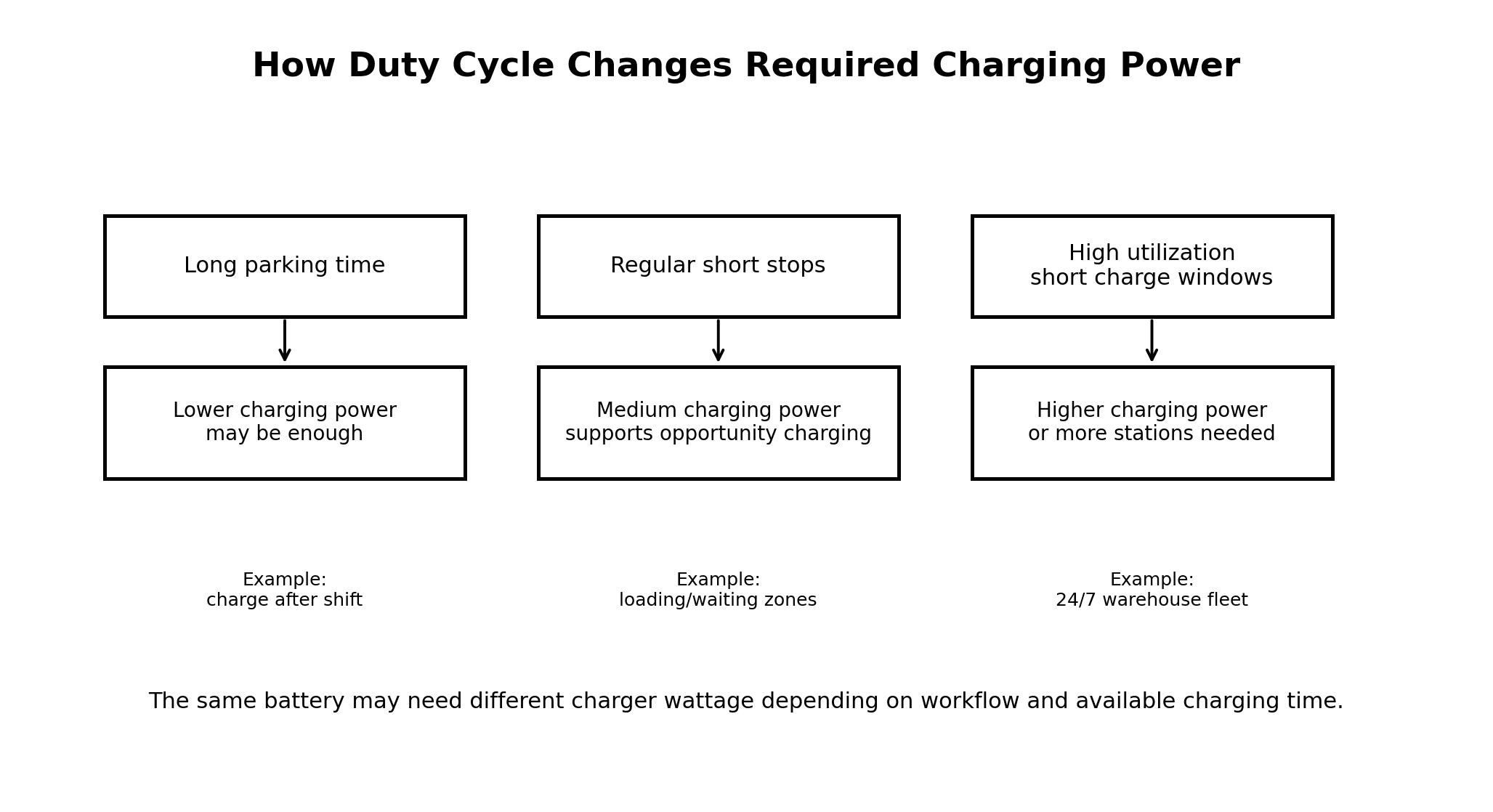
How Duty Cycle Changes Charging Power
Duty cycle means how the AGV or AMR works during the day. A robot that works for one shift and charges overnight has very different charging needs from a robot that works continuously across multiple shifts.
Low-Duty-Cycle Robot
A low-duty-cycle robot may have long idle time. In this case, a lower-power charger may be enough because the robot has more time to recover energy.
Example use cases:
- Small warehouse robot
- Service robot
- Prototype AMR
- Robot that charges after each shift
- Light-duty industrial cart
Medium-Duty-Cycle Robot
A medium-duty robot may need regular charging throughout the day. This is where wireless charging becomes useful because the robot can charge automatically during planned stops.
Example use cases:
- Warehouse AMR
- Light AGV
- Conveyor AGV
- Material delivery robot
- Production-line support robot
High-Duty-Cycle Robot
A high-duty-cycle robot has short charging windows and high energy demand. It may need higher charging power, more charging stations, or a more carefully designed opportunity charging strategy.
Example use cases:
- Multi-shift warehouse AGV
- Heavy-duty AMR
- Factory logistics robot
- High-payload mobile robot
- 24/7 automated material handling system
Opportunity Charging and Power Selection
Opportunity charging means the robot charges during short available moments instead of waiting for one long charging session. This can happen at loading points, unloading points, parking zones, waiting areas, or route stops.
Opportunity charging changes the power calculation.
If an AGV has 8 hours of total working time but only 60 minutes of available charging time across the shift, the charger must recover enough energy during that limited time. If the robot has 3 hours of total idle or waiting time, a lower power charger may be enough.
Why BMS Charging Limits Matter
The battery management system controls safe charging behavior. Even if you select a powerful charger, the BMS may limit how much current the battery can accept.
Before choosing charging power, confirm:
- Maximum charging current
- Maximum charging voltage
- Battery chemistry
- Charging temperature range
- Charging profile
- BMS communication requirements
- Overvoltage and overcurrent protection
- Cell balancing behavior
- Whether the charger should connect directly or through a charge control circuit
This is especially important for lithium battery systems. Many lithium battery packs use controlled charging behavior and need protection against overcharge, overheating, excessive current, and unsafe temperature conditions.
Wireless Charging Efficiency and Power Margin
Wireless charging systems are not 100% efficient. Some energy is lost in the transmitter, receiver, coils, air gap, power conversion, and thermal dissipation.
Efficiency can be affected by:
- Air gap
- Coil alignment
- Coil size
- Coil material
- Charging power
- Enclosure material
- Temperature
- Foreign objects
- Power electronics design
- Receiver mounting position
Because of this, the charger may need a margin above the simple battery-energy calculation.
For example, if the battery needs 600W of effective charging power and the total system efficiency is below 100%, the transmitter-side power requirement may be higher than 600W. The exact margin should be confirmed during design and testing.
Thermal Design Considerations
Higher charging power usually creates more heat. Heat may appear in the transmitter unit, receiver unit, coils, battery area, or enclosure.
Thermal design is important because AGVs and AMRs often have compact bodies with limited airflow. If the receiver module is installed inside a sealed robot, the charging system may need current limiting, temperature monitoring, better heat spreading, or a custom mechanical layout.
Consider:
- Ambient temperature
- Charging duration
- Receiver location
- Coil temperature
- Battery temperature
- Enclosure material
- Ventilation
- Cooling path
- Maximum surface temperature
- Duty cycle
The goal is not only to reach the desired wattage once. The goal is to charge reliably under real operating conditions.
Air Gap and Alignment Effects
For wireless charging, the air gap is the distance between the transmitter coil and receiver coil. Alignment refers to how well the two coils line up.
A larger air gap or poor alignment can reduce efficiency and increase heat. This may require:
- Larger coil design
- Better docking accuracy
- Mechanical guide structure
- Lower charging power
- More thermal margin
- Custom transmitter and receiver layout
If your AGV or AMR has unusual ground clearance, side-mounted charging, curved body panels, or strict space limits, a custom coil or custom module design may be needed.
When 200W Is Enough
A 200W wireless charging system may be enough when:
- The robot has a small battery
- The robot has long parking or idle time
- The charging goal is battery maintenance rather than fast recovery
- The duty cycle is light
- The project is a prototype or low-power industrial device
- Space or heat limits make higher power difficult
- The battery/BMS cannot accept higher current
A 200W system can be useful for smaller AMRs, service robots, industrial sensors, embedded devices, or applications where long-distance wireless charging is more important than fast charging.
When 800W Makes More Sense
An 800W wireless charging module may make more sense when:
- 200W charging is too slow
- The robot needs regular opportunity charging
- The battery capacity is medium-sized
- The AGV or AMR runs for long hours
- Charging time is limited
- The system needs a stronger industrial charging solution
- The project needs a balance between charging speed and integration complexity
ONEPOINTECH’s 800W wireless charging modules can be a good fit for medium-duty AGV, AMR, robot, and industrial automation projects where buyers need more charging power than small embedded wireless charging modules can provide.
When Custom Charging Power Is Needed
Custom charging power may be needed when:
- The battery voltage is not standard
- The required current is unusual
- The robot has very limited receiver space
- The air gap is larger than normal
- The alignment tolerance is difficult
- The enclosure material affects performance
- The system needs special communication
- The project has strict environmental requirements
- The charging station must fit a custom mechanical structure
- The customer needs OEM integration or production support
In these cases, ONEPOINTECH can help evaluate transmitter, receiver, coil, power output, mounting, and system integration requirements.
Common Mistakes When Choosing Charging Power
Mistake 1: Choosing Power Only by Battery Capacity
Battery capacity is important, but charging time and duty cycle are equally important. The same battery may need 200W, 600W, or 1kW depending on how much charging time is available.
Mistake 2: Ignoring the BMS
The charger must respect the battery and BMS limits. A higher-power charger does not help if the BMS restricts charging current.
Mistake 3: Forgetting Efficiency Loss
Wireless charging has conversion losses. Planning should include efficiency margin, thermal margin, and real-world testing.
Mistake 4: Ignoring Air Gap and Alignment
A charger that works well at a small air gap may perform differently when installed on the actual robot. Mechanical design and docking accuracy matter.
Mistake 5: Not Considering Heat
Higher power can create more heat. Always check receiver temperature, coil temperature, battery temperature, and enclosure temperature.
Mistake 6: Comparing Wattage Without Understanding Use Case
A 200W charger and an 800W charger are not “good” or “bad” by themselves. They are suitable for different batteries, workflows, charging windows, and mechanical designs.
Charging Power Selection Checklist
Before requesting a recommendation, prepare this information:
| Requirement | What to Prepare |
|---|---|
| Robot type | AGV, AMR, service robot, warehouse robot, industrial vehicle |
| Battery voltage | 24V, 36V, 48V, or custom |
| Battery capacity | Ah or Wh rating |
| Battery chemistry | Lithium, LiFePO4, lead-acid, or other |
| Maximum charging current | BMS or battery limit |
| Desired charging time | Full charge time or opportunity charging window |
| Operating schedule | Single shift, multi-shift, 24/7 |
| Charging strategy | Overnight charging, scheduled charging, opportunity charging |
| Available air gap | Distance between transmitter and receiver |
| Alignment tolerance | Expected docking accuracy |
| Receiver mounting space | Length, width, height, and location |
| Transmitter installation | Floor, wall, dock, embedded station, or custom |
| Environment | Indoor, outdoor, dusty, wet, cold, hot, cleanroom |
| Communication | CAN, RS485, UART, GPIO, or none |
| Safety requirements | Overcurrent, overvoltage, over-temperature, FOD, EMC |
| Quantity | Sample, pilot run, or mass production |
| Timeline | Prototype and production schedule |
FAQ: Charging Power for AGV and AMR Batteries
How much charging power does an AGV need?
It depends on battery voltage, battery capacity, charging time, duty cycle, and BMS limits. A light-duty AGV may only need a few hundred watts, while a high-utilization AGV may need 800W, 1kW, or a custom system.
How much charging power does an AMR need?
Small AMRs may use 100W–300W charging, while medium industrial AMRs may need 300W–800W. Heavy-duty or high-utilization AMRs may need higher power, depending on battery size and available charging time.
Is 200W enough for an AGV or AMR?
200W can be enough for smaller robots, longer idle times, or light-duty applications. It may not be enough for larger batteries, short charging windows, or multi-shift industrial operation.
When should I choose an 800W wireless charging module?
An 800W module is useful when the robot needs faster charging than 200W can provide, but the project does not require a much larger high-power system. It can be suitable for medium-duty AGVs, AMRs, and industrial robots.
How do I calculate charging power from battery capacity?
Start with battery energy:
Wh ≈ V × Ah
Then divide by available charging time:
W ≈ Wh ÷ charging hours
For wireless charging, add efficiency and safety margin.
Does higher charging power reduce battery life?
Charging power must stay within the safe charging current and temperature range of the battery. Excessive current, heat, or poor charging control can reduce battery life or create safety risks.
Why does opportunity charging need different power planning?
Opportunity charging uses short charging windows. If the robot only charges for short periods, the charger may need higher power to recover enough energy during those stops.
Can wireless charging work with 24V and 48V batteries?
Yes. Wireless charging systems can be designed for 24V, 36V, 48V, or custom battery systems. The receiver output and charging profile must match the battery and BMS.
Does wireless charging power depend on air gap?
Yes. Air gap and alignment affect efficiency and thermal behavior. Larger gaps or poor alignment may require different coil design, more margin, or lower charging power.
What should I send to ONEPOINTECH for a recommendation?
Send battery voltage, battery capacity, battery chemistry, maximum charging current, target charging time, duty cycle, air gap, alignment tolerance, mounting space, environment, communication needs, quantity, and timeline.
Conclusion
Choosing charging power for AGV and AMR batteries is not only a wattage decision. It is a system design decision involving battery capacity, charging time, duty cycle, BMS limits, wireless charging efficiency, heat, air gap, alignment, and mechanical integration.
A 200W charger may be suitable for small robots or long idle times. An 800W wireless charging module may be better for medium-duty AGVs and AMRs that need faster opportunity charging. Largers systems like 1.5kw and 3kw or custom systems may be needed for heavy-duty vehicles, short charging windows, or special industrial environments.
If you are not sure what power level your AGV or AMR needs, ONEPOINTECH can help evaluate your battery data, workflow, charging window, mounting space, and integration requirements.
Need help choosing the right wireless charging power for your AGV or AMR?
Send ONEPOINTECH your battery voltage, battery capacity, maximum charging current, target charge time, available air gap, alignment tolerance, and estimated quantity. Our engineering team can recommend a suitable 200W, 800W, 1.5kw, 3kw or custom wireless charging solution for your industrial robot project.