
What if your robots could grab a quick charge without ever stopping to plug in? That’s the reality for teams using the TF02 800W wireless charging module from ONEPOINTECH. We’ve helped clients in warehouses and factories cut out those annoying downtime headaches. No more fumbling with cables or risking sparks in busy spots.
This module isn’t just another gadget—it’s built for real industrial use, like powering humanoid robots or AGVs. With the global robot charging station market hitting around USD 7.8 billion and growing fast due to automation demands, solutions like this are becoming must-haves.
In this post, I’ll break down the specs, how it works, and why it’s worth considering, based on the official datasheet and what we’ve seen in the field. If you’re an engineer or buyer scouting 800W wireless charging modules for robotics, stick around for the details.
Specs Breakdown: What You’re Getting
Straight from ONEPOINTECH’s datasheet, here’s the nitty-gritty on the TF02. I’ve tabled it for quick reference—engineers love this format for comparing options.
| Feature | Transmitter (Tx) | Receiver (Rx) |
|---|---|---|
| Power Input | DC 48V/20A | N/A |
| Power Output | N/A | DC 54.2V/15A (800W Max) |
| Efficiency | 93% @ 30mm | 93% @ 30mm |
| Misalignment | ±15mm | ±15mm |
| Charging Distance | 25–35mm (coil to coil) | 25–35mm (coil to coil) |
| Dimensions | PCBA: 130x130x26mm; Coil: 140x135x6mm | PCBA: 130x130x23mm; Coil: 140x135x6mm |
| Protections | FOD, OCP, OVP, OTP | FOD, OCP, OVP, OTP |
| Standby Power | 1W Max | 1W Max |
| Operating Temperature | -20 to 55°C (-4 to 131°F) | -20 to 55°C (-4 to 131°F) |
| Storage Temperature | -40 to 70°C (-40 to 158°F) | -40 to 70°C (-40 to 158°F) |
| Operating Humidity | 15 to 85% RH (Non-dewing) | 15 to 85% RH (Non-dewing) |
| Storage Humidity | 5 to 95% RH (Non-dewing) | 5 to 95% RH (Non-dewing) |
Compact, right? The PCBA fits into tight robot frames, and that 93% efficiency means you’re not wasting power on heat. We’ve shipped these to clients who needed something rugged for dusty or cold environments—no complaints yet.
The Basics: How This Charger Actually Works
No need for a physics lesson here. The TF02 relies on inductive coupling—basically, magnetic fields zap power from the transmitter coil to the receiver without touching. It’s simple to set up:
- Hook the Tx to your DC 48V/20A source—it creates the field.
- Position the Rx on your robot; it picks up the energy across a 25–35mm gap, even if alignment’s off by ±15mm.
- Boom: Up to 800W flows out as DC 54.2V/15A to your battery.
- Safety kicks in automatically—FOD spots junk like metal scraps, while OCP, OVP, and OTP handle overloads or heat.
This setup lets robots “opportunity charge” during short breaks, keeping things moving. For a visual, check this typical wireless setup for AGVs—it’s similar to how the TF02 integrates.
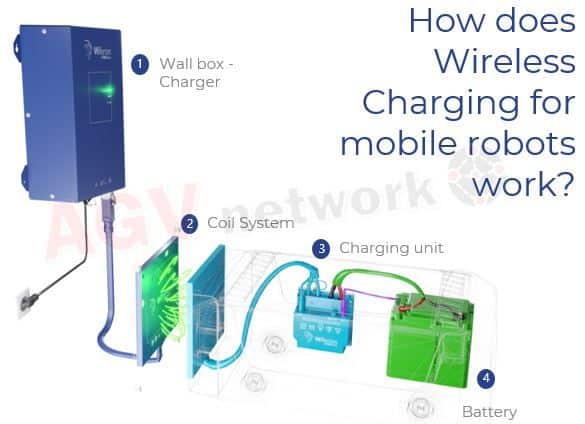
Source: AVGNETWORK
And here’s a close-up of our TF02 800W wireless charging module

Why Bother? Real Benefits for Your Setup
Switching to wireless isn’t hype—it’s practical. From what we’ve observed and industry reports, here’s what you gain:
- Zero Manual Hassle: Forget plugs that wear out or get dirty. Robots charge hands-free, slashing labor and safety risks in tight spaces.
- Less Downtime: Opportunity charging means bots top up mid-task, potentially cutting stops by a big margin—some setups see major reductions in idle time. One client reported smoother 24/7 runs without battery swaps.
- Tough and Safe: Those protections (FOD, etc.) prevent accidents, and the temp/humidity range handles warehouses or outdoor gigs without flinching.
- Power Savings: 93% efficiency and 1W standby keep bills down—add up to 20-30% lower costs long-term in energy-hungry ops.
- Easy Fit: Small size means it slots into existing designs. As distributors, we often bundle it with custom mounts for quick installs.
With the AGV charging market eyeing $1.4 billion by 2031, these perks explain why more teams are going wireless.
Where It Fits: Everyday Examples
The TF02 is versatile for all sorts of robotics setups, especially where high power and reliability matter. We’ve seen similar 800W modules tackle real-world jobs in manufacturing, logistics, and beyond—here are some solid examples to spark ideas for your projects.
- Humanoid Robots in Assembly Lines: These bots can dock at a charging station between tasks, like picking parts or welding, without needing a human to plug them in. It keeps the line moving smoothly in auto factories.
- AGVs in Logistics Warehouses: Floor-mounted Tx coils let AGVs recharge during loading/unloading stops, handling heavy pallets in e-commerce hubs like Amazon-style facilities—no more sideline time for cables.
- AMRs in Manufacturing Plants: Autonomous mobile robots shuttle materials between stations; they pause briefly over pads to charge, boosting efficiency in 24/7 ops without workflow breaks.
- Medical Delivery Robots in Hospitals: In clean environments, these bots deliver supplies or meds, charging at hallway stations during downtime— the IP-rated durability handles sterile, humid conditions.
- Inspection Robots in Hazardous Areas: For oil rigs or construction sites, rovers scan for issues and recharge at base pads; the wide temp range (-20 to 55°C) means they thrive in extreme weather without plug worries.
- Factory Floor Robots for Material Handling: Think pallet jacks or tuggers—they align over coils for quick top-ups, reducing wear in high-traffic zones like food processing or automotive assembly.
Think of it for your fleet: If plugs are slowing you, this could be the fix. Here’s an example of an AGV setup in action.

Source: AVGNETWORK
Wrapping Up: Give It a Shot
The TF02 800W module from ONEPOINTECH is straightforward tech that solves real problems in robotics charging. It’s efficient, safe, and built to last—exactly what our clients ask for.
Curious? Contact us at info@onepointech.com for quotes, samples, or advice. At ONEPOINTECH, we’re all about making your setup run smoother—let’s chat.