
Opportunity charging is a charging strategy where AGVs and AMRs receive short, automatic charging sessions during natural stops in their workflow instead of waiting for one long charging break. For industrial fleets, this can help reduce downtime, improve battery availability, and support more continuous operation.
In a traditional charging model, a robot may work until its battery becomes low, then leave the workflow and park for a long charging session. In an opportunity charging model, the robot charges during short stops at loading points, unloading points, waiting zones, parking areas, or route checkpoints. These small charging sessions help keep the battery within a more useful operating range throughout the day.
For AGV and AMR fleets that operate in warehouses, factories, logistics centers, cleanrooms, and automated production lines, opportunity charging can be especially powerful when combined with wireless charging. A wireless charging station allows the vehicle to charge automatically without plugs, manual connection, or exposed charging contacts.
What Is Opportunity Charging?
Opportunity charging means charging a battery whenever there is a suitable opportunity during operation.
For AGVs and AMRs, these opportunities may include:
- Waiting for a loading or unloading task
- Parking between missions
- Stopping at a conveyor transfer point
- Waiting near a production line
- Returning to a staging area
- Pausing during low-demand periods
- Sitting in a queue before the next task
Instead of treating charging as a separate activity, opportunity charging makes charging part of the normal workflow.
The goal is not always to fully charge the robot during every stop. The goal is to add enough energy during short stops so the robot can stay available for longer periods and avoid deep battery depletion.
For a broader overview of contactless power in industrial environments, see ONEPOINTECH’s guide to industrial wireless charging.
Why AGV and AMR Fleets Need a Different Charging Strategy
AGVs and AMRs are not like handheld devices or consumer electronics. They are part of a production or logistics system. When one robot is unavailable, the whole workflow may be affected.
A poor charging strategy can cause:
- More robots waiting for chargers
- Longer task delays
- Lower fleet utilization
- More manual charging labor
- More battery-related downtime
- Larger battery requirements
- More charging stations than necessary
- Unstable operation during peak demand
- Higher long-term maintenance cost
A good charging strategy should match the robot’s duty cycle, battery size, charging power, available stopping points, and fleet management logic.
Opportunity charging is useful because it focuses on keeping the fleet moving instead of simply charging batteries after they become low.
Opportunity Charging vs Scheduled Charging vs Manual Charging
There are several common charging strategies for AGV and AMR fleets.
| Charging Strategy | How It Works | Best For | Main Limitation |
|---|---|---|---|
| Manual charging | Operator connects the robot to a charger | Small fleets, low automation | Requires labor and can be inconsistent |
| End-of-shift charging | Robot charges after work is finished | Single-shift operations | Not ideal for multi-shift or 24/7 workflows |
| Scheduled charging | Robot charges at fixed times or battery levels | Predictable routes and schedules | May interrupt workflow if timing is poor |
| Opportunity charging | Robot charges during natural stops | Automated fleets, high utilization | Requires good station placement and power planning |
| Battery swapping | Battery is replaced instead of charged in place | Some heavy-duty use cases | Adds battery inventory and mechanical complexity |
Opportunity charging does not replace every other method. It is most useful when the robot fleet has repeatable stopping points and the facility wants more continuous operation.
How Opportunity Charging Works in a Warehouse or Factory
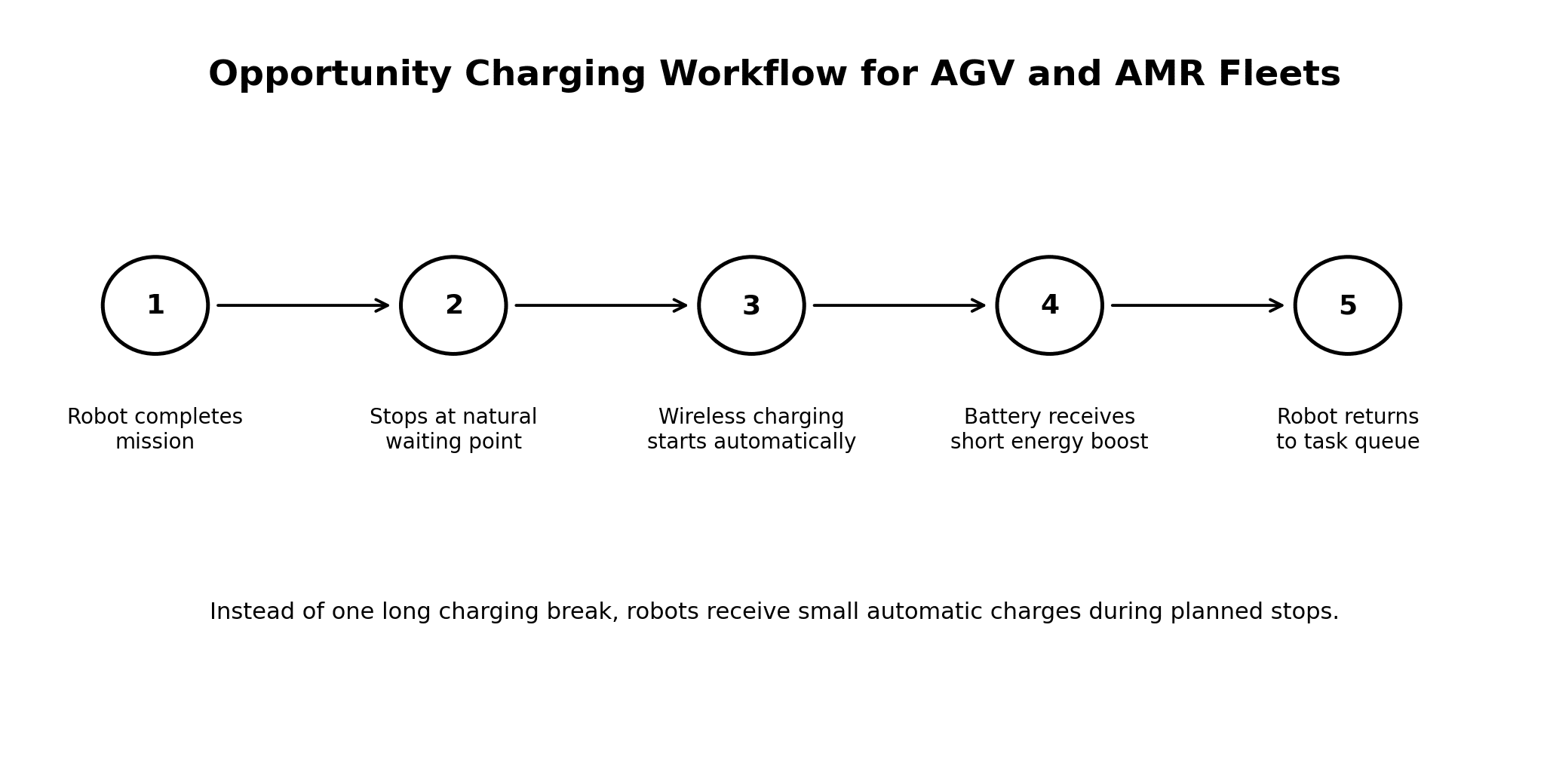
A typical opportunity charging system follows this process:
- The robot completes a task or reaches a natural waiting point.
- The fleet management system checks battery level, task priority, and charger availability.
- The robot stops at a charging position.
- The charging station detects the vehicle.
- Charging starts automatically.
- The battery receives a short energy boost.
- Charging stops when the next task begins or the target charge level is reached.
- The robot returns to operation.
In a warehouse, charging stations may be installed near receiving, storage, picking, shipping, and parking zones. In a factory, they may be placed near production lines, transfer stations, work-in-progress buffers, or staging areas.

The best charging locations are usually not random. They should be placed where robots already slow down, wait, load, unload, or park. If the robot must travel far away from its normal route to charge, the charging station may reduce efficiency instead of improving it.
Why Wireless Charging Fits Opportunity Charging
Wireless charging is a strong match for opportunity charging because it removes the need for physical plug-in connection or exposed charging contacts.
With contact-based charging, the robot must create reliable physical contact with the charging station. In clean and controlled environments, this can work well. But in dusty, wet, oily, high-use, or high-vibration environments, contacts may need cleaning, replacement, or mechanical adjustment.
Wireless charging allows the AGV or AMR to charge through a transmitter and receiver system. The vehicle only needs to align within the designed charging tolerance.
Wireless charging can support opportunity charging because:
- Charging can start automatically
- No worker needs to connect a cable
- There are no exposed charging contacts during normal charging
- Mechanical contact wear is reduced
- The charging interface can be easier to seal
- Robots can charge during short stops
- Charging stations can be installed at natural workflow points
- The system can support more automated fleet operation
For compact industrial robots or lower-power systems, ONEPOINTECH’s 200W wireless charging module may be suitable when the robot has longer idle time or lower energy demand.
For medium-duty AGV and AMR projects that need faster opportunity charging, ONEPOINTECH’s 800W wireless charging module may be a better fit.
For high-power industrial vehicle charging, ONEPOINTECH’s 3000W wireless charger may be relevant when the battery system and workflow require much higher charging power.
Battery Level: Manual Charging vs Opportunity Charging
In a manual or end-of-shift charging model, the battery level often drops for a long period and then rises during a long charging session. This can work for single-shift operations, but it may not be ideal for continuous automation.
In an opportunity charging model, the battery receives smaller energy boosts throughout the day. The battery may stay within a more stable operating range, depending on charge planning, battery chemistry, and BMS settings.
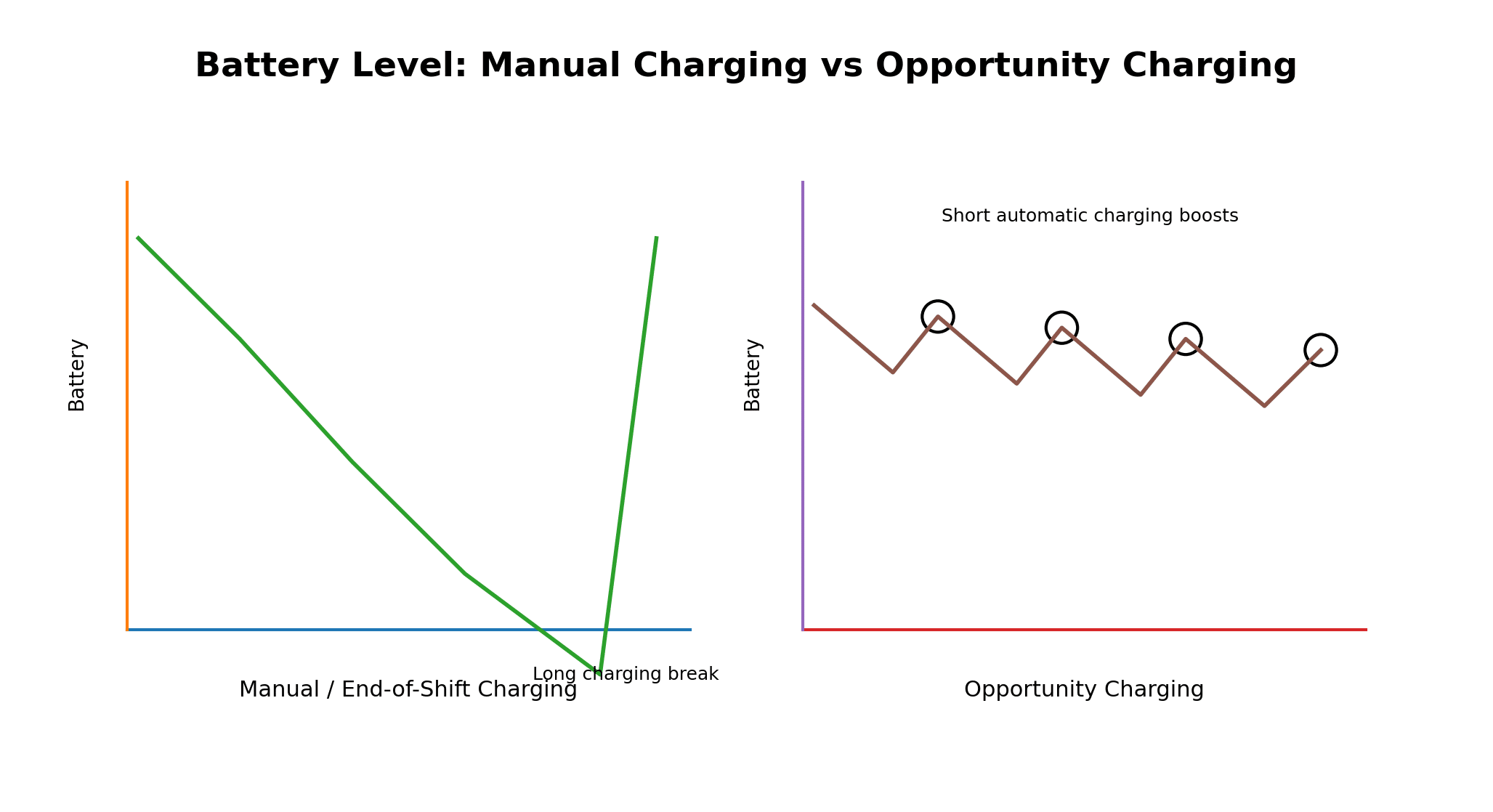
This does not mean opportunity charging is automatically better for every battery. The charging current, temperature, state of charge window, and BMS control strategy must still be designed properly.
How to Choose Charging Station Locations
Charging station placement is one of the most important parts of opportunity charging design.
Good charging station locations include:
| Location | Why It Works |
|---|---|
| Loading stations | Robots often wait while goods are loaded |
| Unloading stations | Robots may stop before the next task |
| Conveyor transfer points | Natural stop position for material transfer |
| Parking areas | Good for idle-time charging |
| Staging zones | Useful before peak demand periods |
| Production line buffers | Robots may wait for line availability |
| Shipping zones | Good for warehouse flow |
| Maintenance areas | Useful for backup charging |
Poor charging station locations include:
- Areas far away from normal routes
- Congested traffic zones
- Places where robots cannot stop safely
- Locations with poor alignment conditions
- Areas exposed to water, impact, or damage without protection
- Positions that interrupt loading, unloading, or human movement
A good location should reduce downtime, not create extra travel time.
How Charging Power Affects Opportunity Charging
Charging power determines how much energy the robot can recover during each short stop.
A low-power charger can work when:
- The robot has frequent or long idle periods
- The battery is small
- Energy consumption is low
- The robot does not need fast recovery
- The system is used for maintenance charging or light-duty operation
A higher-power charger is useful when:
- Charging windows are short
- Battery capacity is larger
- The robot operates for long hours
- The fleet must support multiple shifts
- The robot has high energy consumption
- Charging stations are limited
- The facility wants more continuous operation
As a general direction:
| Project Type | Charging Power Direction |
|---|---|
| Small robot, sensor platform, light-duty AMR | 200W range may be enough |
| Medium AGV or AMR with regular opportunity charging | 800W range may be suitable |
| Heavy industrial vehicle or short charging windows | 3000W or custom system may be needed |
These are planning directions, not final specifications. Final selection depends on battery voltage, battery capacity, maximum charging current, air gap, alignment tolerance, receiver size, thermal design, and operating environment.
ONEPOINTECH can help evaluate whether a 200W wireless charging module, 800W wireless charging module, 1500W LC180-A30, 3000W wireless charger LS300-A60, or custom wireless charging solution is the better match for your project.
Battery and BMS Considerations
Opportunity charging must be designed around the battery and BMS, not only the charger.
Before designing an opportunity charging system, confirm:
- Battery voltage
- Battery capacity
- Battery chemistry
- Maximum charging current
- Recommended charging temperature range
- BMS charging limits
- BMS communication requirements
- Charging profile
- State of charge operating range
- Cell balancing behavior
- Overvoltage and overcurrent protection
- Whether charging can start and stop frequently
For lithium battery systems, charging behavior is usually controlled by voltage, current, temperature, and protection logic. The charger should not force power into a battery beyond the BMS limits.
If the robot uses a custom battery pack, the charging system should be tested together with the battery and BMS before fleet deployment.
Does Opportunity Charging Damage the Battery?
Opportunity charging does not automatically damage the battery. In many industrial systems, shorter and more frequent charging sessions can be part of a normal battery management strategy.
However, battery life depends on many factors, including:
- Battery chemistry
- Charging current
- Temperature
- State of charge range
- Depth of discharge
- BMS quality
- Charging profile
- Cell balancing
- Operating environment
- Mechanical vibration and heat
The key is not simply whether the robot charges frequently. The key is whether the battery is charged within its safe voltage, current, temperature, and state-of-charge limits.
For industrial AGV and AMR projects, the charger, battery, BMS, and fleet operation strategy should be designed together.
How Many Opportunity Charging Stations Does a Fleet Need?
There is no universal number. The required number of charging stations depends on fleet size, route design, battery capacity, charging power, waiting time, and peak workload.
Start with these questions:
- How many robots are in the fleet?
- How much energy does each robot use per hour?
- How many hours per day does the fleet operate?
- Where do robots naturally wait?
- How long is each natural stop?
- How much energy can be recovered during each stop?
- How many robots may need charging at the same time?
- What happens during peak demand?
- Is there a backup charging area?
- Can the fleet management system assign robots to available chargers?
A small fleet may only need one or two charging locations. A large warehouse or production system may need multiple charging stations placed across the workflow.
Opportunity Charging Design Example
Imagine a medium-duty AMR that moves materials between storage and shipping areas.
The robot does not have time for long charging sessions during peak hours, but it often waits at loading and unloading areas for several minutes. Instead of sending the robot back to a separate charging room, the facility installs wireless charging stations at two natural waiting points.
During each stop, the AMR receives a short energy boost. Over the shift, these short sessions help keep the battery level within a useful range. The robot spends less time traveling away from the workflow and more time available for tasks.
For this kind of application, an 800W wireless charging module may be more practical than a lower-power charger if the charging windows are short. For smaller robots or longer idle time, a 200W module may be enough. For heavier vehicles or higher energy demand, a 3000W or custom system may be needed.
When Opportunity Charging Makes Sense
Opportunity charging is a strong fit when:
- The fleet operates for multiple shifts
- Robots have natural waiting points
- Manual charging creates labor cost
- Battery swapping is inconvenient
- Long charging breaks reduce productivity
- The facility needs higher robot availability
- Charging can be integrated into the normal route
- The robot can align reliably with a charging station
- Charging stations can be placed safely
- The battery and BMS support frequent controlled charging
When Opportunity Charging May Not Be Necessary
Opportunity charging may not be necessary when:
- The fleet is small
- Robots only work one shift
- Long overnight charging is enough
- The robot has a very large battery
- There are few natural stopping points
- Charging station placement is difficult
- The workflow does not require high availability
- Manual charging cost is acceptable
- The budget is focused on the lowest initial cost
The best strategy depends on the cost of downtime. If robot downtime is expensive, opportunity charging becomes more attractive.
Common Mistakes in Opportunity Charging Design
Mistake 1: Placing Chargers Away from the Workflow
If a robot must travel far away to charge, the charging station may waste time. Place chargers where robots already stop.
Mistake 2: Choosing Charging Power Without Studying Stop Time
A charger that works for a 30-minute stop may not be enough for a 5-minute stop. Charging power must match the real charging window.
Mistake 3: Ignoring Peak Demand
A fleet may work well during normal hours but fail during peak workload if too many robots need charging at the same time.
Mistake 4: Forgetting Battery and BMS Limits
A high-power charger cannot solve the problem if the battery or BMS cannot accept the current safely.
Mistake 5: Treating Wireless Charging as Only an Electrical Product
Wireless charging also involves mechanical alignment, mounting space, air gap, floor condition, enclosure design, and thermal management.
Mistake 6: Not Testing with Real Routes
A charging plan should be tested with real route timing, traffic, robot positioning accuracy, and operating temperature.
Opportunity Charging Specification Checklist
Before asking for a recommendation, prepare the following information:
| Requirement | What to Prepare |
|---|---|
| Robot type | AGV, AMR, cart, mobile robot, industrial vehicle |
| Fleet size | Number of robots now and future expansion |
| Battery voltage | 24V, 36V, 48V, or custom |
| Battery capacity | Ah or Wh rating |
| Battery chemistry | Lithium, LiFePO4, lead-acid, or other |
| Maximum charging current | BMS or battery limit |
| Charging window | Minutes available per stop |
| Operating schedule | Single shift, multi-shift, 24/7 |
| Route layout | Main paths, waiting points, loading/unloading zones |
| Charging station locations | Floor, wall, dock, parking zone, loading station |
| Air gap | Distance between transmitter and receiver |
| Alignment tolerance | Expected parking accuracy |
| Receiver mounting space | Available size on the robot |
| Environment | Indoor, outdoor, wet, dusty, cold, hot, cleanroom |
| Communication needs | CAN, RS485, UART, GPIO, or no communication |
| Target product | 200W, 800W, LC180-A30, 3000W, or custom system |
| Quantity | Sample, pilot, or production |
| Timeline | Prototype and mass production schedule |
FAQ: Opportunity Charging for AGV and AMR Fleets
What is opportunity charging?
Opportunity charging is a strategy where AGVs or AMRs charge during short natural stops instead of waiting for one long charging session. These stops may happen at loading zones, parking areas, waiting points, or transfer stations.
Why is opportunity charging useful for AGV and AMR fleets?
It helps robots recover energy during the workday, reduce long charging breaks, and stay available for more tasks. It is especially useful for multi-shift or high-utilization fleets.
Is wireless charging required for opportunity charging?
No, but wireless charging makes opportunity charging easier to automate because it removes manual plug-in work and exposed charging contacts.
How long should each opportunity charging stop be?
It depends on battery size, charging power, energy consumption, and workflow. Some robots may benefit from short stops of several minutes, while others may need longer charging windows.
How many charging stations does a fleet need?
It depends on fleet size, route layout, battery capacity, charger power, and peak demand. The best locations are usually places where robots already stop or wait.
Does opportunity charging damage lithium batteries?
Not automatically. Battery life depends on charging current, temperature, state of charge range, battery chemistry, and BMS control. Opportunity charging should stay within the safe limits of the battery and BMS.
What charging power is best for opportunity charging?
Small robots may use around 200W. Medium-duty AGVs and AMRs may need around 800W. Heavy-duty vehicles or very short charging windows may need 3000W or a custom system.
Can one charging station serve multiple robots?
Yes, if the route design, fleet schedule, and charging time allow it. But if many robots need charging during the same period, more stations may be required.
Where should wireless opportunity charging stations be installed?
Good locations include loading stations, unloading stations, parking zones, staging areas, conveyor transfer points, and places where robots naturally wait.
What should I send to ONEPOINTECH for an opportunity charging recommendation?
Send your robot battery voltage, battery capacity, maximum charging current, fleet size, route layout, available charging time, target charging locations, air gap, alignment tolerance, environment, and estimated quantity.
Conclusion
Opportunity charging changes the way AGV and AMR fleets think about energy. Instead of removing robots from operation for long charging breaks, the fleet can recover energy during natural stops in the workflow.
Wireless charging is especially useful for this strategy because it supports automatic, contactless charging without plugs or exposed charging contacts. A 200W wireless charging module may fit small robots or light-duty systems, an 800W module may fit medium-duty AGV and AMR opportunity charging, and a 3000W wireless charger may be suitable for higher-power industrial vehicles or short charging windows.
The best system depends on battery voltage, battery capacity, charging window, duty cycle, air gap, alignment tolerance, BMS limits, and station placement.
Planning an opportunity charging system for AGV or AMR fleets?
Send ONEPOINTECH your fleet size, battery voltage, battery capacity, maximum charging current, route layout, available stop time, air gap, alignment tolerance, and charging station locations. Our engineering team can help recommend a suitable 200W, 800W, 1500W, 3000W, or custom wireless charging solution for your project.