
Fast charging technology has revolutionized how we power our devices, with innovations allowing a typical smartphone to reach 50% battery in as little as 5 minutes. But what exactly is a fast charger? This comprehensive guide dives into wattage basics, leading technologies like Quick Charge and Power Delivery, compatibility factors, and expert tips to choose the best charger for 2025.
Understanding Wattage in Fast Charging
Wattage is the cornerstone of fast charging, representing the rate at which power flows from the charger to your device. Measured in watts (W), it’s calculated using the simple formula: Power (W) = Voltage (V) × Current (A). For example, a standard USB charger at 5V and 1A delivers just 5W, while a fast charger might operate at 9V and 3A for 27W—over five times faster.
Higher wattage means quicker energy transfer, reducing charging times significantly. In 2025, chargers range from 18W for basic smartphones to over 240W for laptops and high-end devices. However, not all devices can handle maximum wattage; they negotiate power levels via smart protocols to prevent damage. According to industry data, using a 65W charger on a compatible phone can cut full charge time from 2 hours to under 45 minutes compared to a 10W option.
Key benefits of higher wattage:
- Faster Speeds: Ideal for large batteries (e.g., 5000mAh+ in modern phones).
- Efficiency: Less heat generation with advanced materials like GaN (Gallium Nitride).
- Versatility: Supports multiple devices, from earbuds to tablets.
Always check your device’s specs—overkill wattage won’t speed things up if unsupported, but it won’t harm either, thanks to built-in safeguards.
Types of Fast Charging Technologies
Fast charging has evolved into specialized protocols tailored to device ecosystems. In 2025, the dominant players are Qualcomm’s Quick Charge and the universal USB Power Delivery (PD). These technologies differ in approach, with varying wattage limits and features. Below, we break them down, including a head-to-head comparison.
Quick Charge
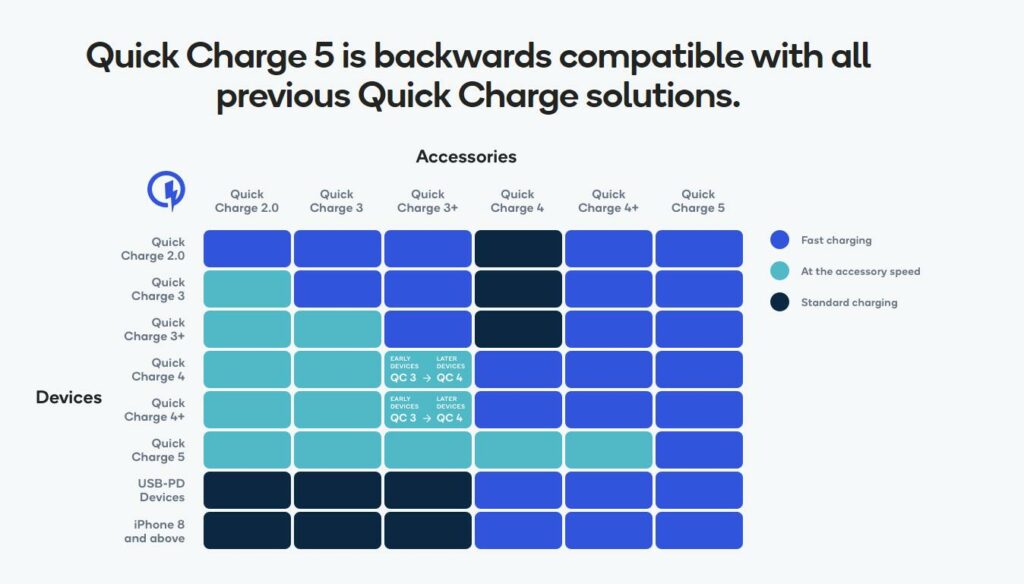
Developed by Qualcomm, Quick Charge (QC) is a proprietary technology optimized for Android devices with Snapdragon processors. Since its debut in 2013, it has iterated to Quick Charge 5 (QC 5), released in 2020 but refined through 2025 updates for better efficiency.
- Maximum Wattage: Over 100W, enabling ultra-fast speeds.
- Charging Speeds: QC 5 can charge a 4500mAh battery from 0% to 50% in just 5 minutes and to 100% in 15 minutes under optimal conditions.
- How It Works: Primarily voltage-based, dynamically adjusting between 3.3V-20V in 200mV increments for precise power delivery via Intelligent Negotiation for Optimum Voltage (INOV).
- Compatibility: Widespread in Android phones (e.g., Samsung, Google Pixel), tablets, and accessories. Backward compatible, but full speeds require matching QC versions.
- Safety Features: Includes overheat protection, overvoltage safeguards, and cooler charging (up to 10°C lower than predecessors).
- Adoption in 2025: Integrated with USB PD for hybrid compatibility, making it more versatile for mixed-device households.
QC excels in speed for Qualcomm-powered gadgets but is less universal than PD.
Power Delivery (PD)
Power Delivery, standardized by the USB Implementers Forum (USB-IF), is an open protocol not tied to any manufacturer. Updated to PD 3.1 in 2021, it remains the go-to for 2025 with no major overhauls needed due to its robust design.
- Maximum Wattage: Up to 240W (via PD 3.1), supporting voltages like 28V (140W), 36V (180W), and 48V (240W).
- Charging Speeds: Variable based on device; for example, a 100W PD charger can fully charge a MacBook Pro in about 1.5 hours, or a smartphone to 50% in 20-30 minutes.
- How It Works: Adjusts both voltage and current (up to 5A), with Programmable Power Supply (PPS) for fine-tuned increments (20mV/50mA) to minimize heat and maximize efficiency.
- Compatibility: Universal across iOS, Android, laptops (e.g., Dell, HP), and accessories. Requires USB-C cables rated for high power.
- Bidirectional Charging: Unique feature allowing devices to swap roles—e.g., a phone charging a laptop or vice versa.
- Safety Features: Smart negotiation prevents overloads, plus temperature monitoring and cable integrity checks.
- Adoption in 2025: Dominant in new devices, especially with USB4 integration for data + power.
PD’s versatility makes it ideal for multi-device users.
Quick Charge vs. PD
While both accelerate charging, QC is Qualcomm-centric and speed-focused, whereas PD prioritizes universality and higher power. Here’s a detailed comparison:
| Feature | Quick Charge (QC 5) | Power Delivery (PD 3.1) |
|---|---|---|
| Developer | Qualcomm | USB-IF |
| Max Wattage | >100W | Up to 240W |
| Charging Speed Example | 0-50% in 5 min (4500mAh battery) | 0-50% in 20-30 min (varies by device) |
| Adjustment Method | Voltage-focused (200mV steps) | Voltage + Current (20mV/50mA steps) |
| Compatibility | Mostly Android/Snapdragon | Universal (iOS, laptops, etc.) |
| Bidirectional | No | Yes |
| Safety & Efficiency | INOV for optimal voltage, heat reduction | PPS for precise power, broad safeguards |
| Best For | Speed on Android devices | Versatile, high-power applications |
In 2025, many chargers support both for hybrid use, but PD edges out for future-proofing.
Device Compatibility & Safety Tips
Matching your charger to your device is key. Check specs: iPhones support PD up to 20-30W, while Androids like Samsung Galaxy handle 45W+. Using a mismatched charger slows speeds but rarely damages—devices cap intake automatically.
Safety Tips for 2025:
- Avoid extreme temperatures (charge between 0-45°C).
- Use certified cables to prevent shorts.
- Enable device settings like “Optimized Battery Charging” to prolong lifespan.
- For GaN chargers, expect cooler, more efficient operation.
Factors Affecting Charging Speed
Charging isn’t just about the charger—multiple variables play a role. Here are 12 key factors, updated for 2025 tech:
- Charger Wattage: Higher W = faster charge; match to device max.
- Device Compatibility: Must support the protocol (e.g., QC or PD).
- Cable Quality: Thick, certified USB-C cables reduce resistance; poor ones lose 20-30% power.
- Device Battery State: Fastest at 0-80%; slows near full to protect cells.
- Battery Capacity: Larger (e.g., 6000mAh) takes longer than smaller ones.
- Charging Technology: PD often outperforms QC for cross-device use.
- Temperature: Optimal at room temp; heat throttles speed by up to 50%.
- Background Processes: Close apps to minimize drain during charge.
- Multi-Device Charging: Power splits, slowing each (e.g., 65W shared = 32.5W each).
- USB Port Type: USB-C > USB-A for power delivery.
- Device Settings: Toggle fast charging on; some have eco modes that limit it.
- Charger Quality: Premium brands ensure stable output; fakes risk instability.
Optimizing these can shave 30-50% off charge times.
How to Choose the Right Fast Charger in 2025
Follow these steps for a smart purchase:
- Review Device Specs: Note recommended W and protocol (e.g., iPhone 16: 30W PD).
- Match Wattage: Aim for equal or slightly higher; e.g., 65W for laptops.
- Check Compatibility: Ensure USB-C/PD or QC support.
- Prioritize Reputable Brands: Like Anker, Belkin, or OnePointTech for safety.
- Seek Certifications: UL-listed, USB-IF certified.
- Avoid Knockoffs: Cheap ones lack protections.
- Consider Fast Tech: GaN for compact, cool charging.
- Opt for Multi-Port: For family use.
- Cable Matters: Buy durable, rated ones.
- Budget for Future-Proof: 100W+ for 2025 devices.
Pro Tip: Invest in GaN chargers—they’re 30% smaller and run cooler.
FAQs
Is a 65W charger safe for my phone?
Yes, if PD-compatible. Devices negotiate to safe levels, preventing overcharge.
What’s the difference between 18W and 30W fast charging?
30W delivers ~67% more power, reducing charge time by 20-40% for compatible devices.
Can I use Quick Charge on an iPhone?
No, iPhones use PD. QC chargers fall back to standard speeds.
How does temperature affect fast charging?
High heat (>35°C) slows charging to protect the battery; keep devices cool.
Is PD better than QC in 2025?
PD is more versatile and supports higher wattage, making it ideal for mixed ecosystems.
What devices support Quick Charge?
QC is mainly for Android devices with Qualcomm Snapdragon chips, such as Samsung Galaxy S6-S10/Note series, LG G4-V50, Xiaomi, OnePlus, and Google Pixels. It’s backward-compatible across versions but requires matching QC-certified chargers for full speed.
Conclusion
Fast charging in 2025 empowers us to stay connected. By mastering wattage, technologies like QC and PD, and optimization factors, you can achieve peak performance safely. Ready to upgrade? Explore ONEPOINTECH’s GaN fast chargers.