
Choosing an AMR charging station is not only a product selection task. It is an engineering specification task.
Before buying a wireless charging station for an autonomous mobile robot, engineers need to define the battery system, charging power, charging strategy, dock style, air gap, alignment tolerance, receiver mounting space, protection features, communication needs, and operating environment.
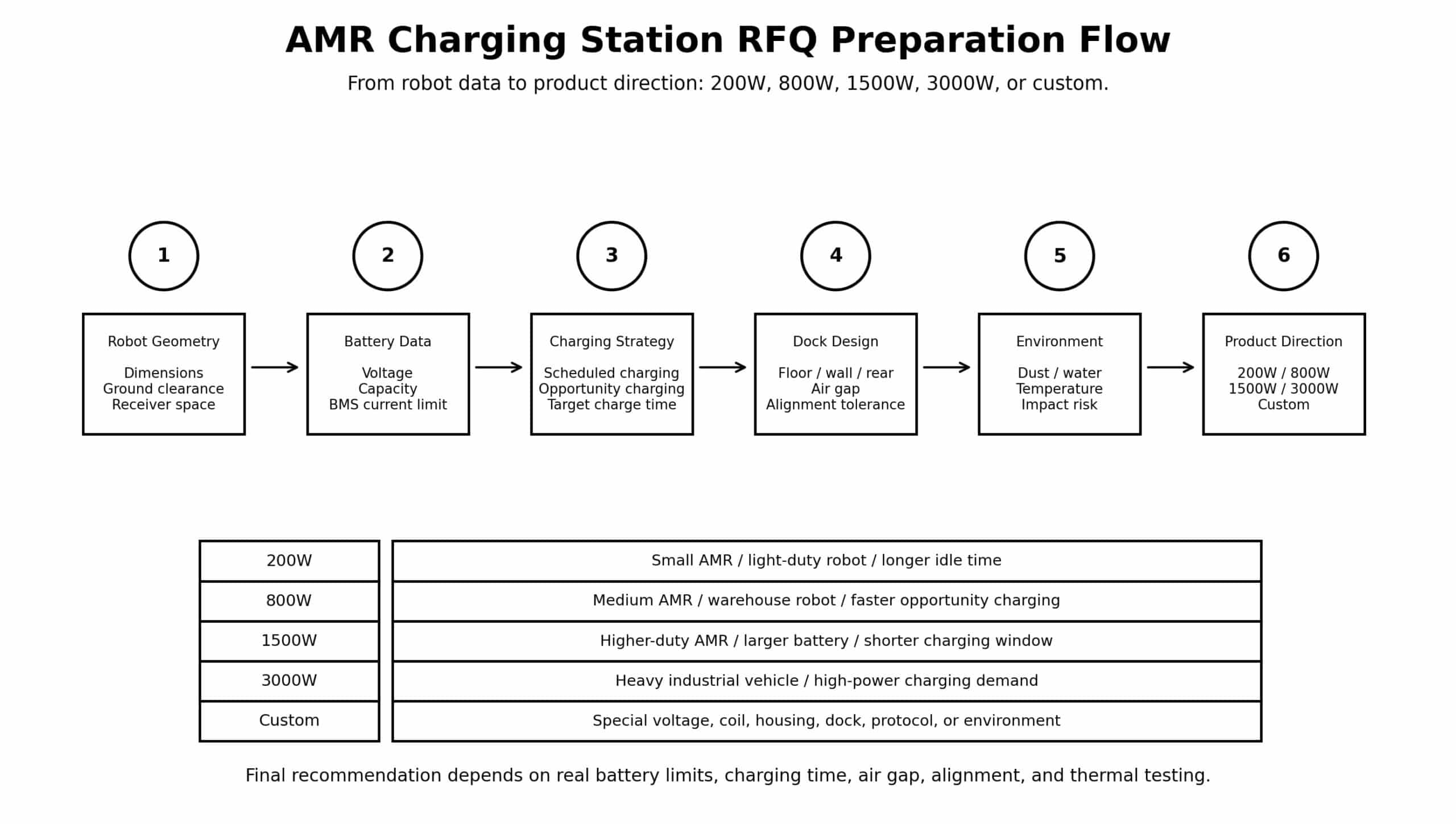
If these details are not clear, the charging system may be oversized, undersized, difficult to install, or unreliable in real operation. A good AMR charging station specification helps the supplier recommend the right product direction, whether that is 200W, 800W, 1500W, 3000W, or a custom wireless charging system.
This guide explains what engineers should prepare before requesting a recommendation from ONEPOINTECH.
Why AMR Charging Station Specification Matters
An AMR charging station directly affects robot uptime, battery life, route planning, maintenance, and fleet availability. A charging station that works in a simple test may still fail in a real warehouse or factory if the specification is incomplete.
Common problems caused by poor specification include:
- Charging power is too low for the workflow
- Charging power exceeds the BMS charging limit
- Receiver module does not fit inside the robot
- Air gap is larger than expected
- Robot parking accuracy is not good enough
- Charging station is installed in the wrong location
- Dock structure causes poor alignment
- Heat builds up inside the robot body
- The charger cannot communicate with the robot controller
- Protection requirements are not clear
- The selected product does not match the operating environment
A proper specification helps avoid these problems before samples are ordered.
For a broader overview of contactless charging in industrial environments, see ONEPOINTECH’s guide to industrial wireless charging.
1. Battery Information to Prepare
The battery is the starting point for any AMR charging station project. Do not start with the charger. Start with the battery and BMS.
Prepare the following battery details:
| Battery Item | Why It Matters |
|---|---|
| Battery voltage | Determines receiver output and charger design |
| Battery capacity | Helps estimate charging power and charge time |
| Battery chemistry | Affects charging profile and safety limits |
| Maximum charging current | Prevents selecting a charger the battery cannot accept |
| Maximum charging voltage | Protects the battery from overvoltage |
| BMS type | Determines whether communication or control signals are required |
| Charging temperature range | Helps define thermal protection |
| Connector or wiring method | Affects installation and integration |
| Cell balancing behavior | May affect charging strategy |
| State of charge operating range | Important for opportunity charging |
Example battery information:
Battery voltage: 48V
Battery capacity: 30Ah
Battery chemistry: LiFePO4
Maximum charging current: 20A
Charging strategy: opportunity charging during short stops
BMS communication: CAN or enable signal required
This information allows the supplier to estimate a realistic charging power range and receiver output requirement.
2. Charging Power Requirements
Charging power should be selected based on battery energy, available charging time, duty cycle, and BMS limit.
A simple planning formula is:
Battery energy Wh ≈ Battery voltage V × Battery capacity Ah
Then:
Required charging power W ≈ Battery energy Wh ÷ Available charging time h
For wireless charging, engineers should also include system efficiency, air gap, alignment, and thermal margin.
For example, a 48V 30Ah battery stores approximately:
48V × 30Ah = 1440Wh
If the AMR has 6 hours to charge, the basic charging power may be around:
1440Wh ÷ 6h = 240W
If the same robot only has 2 hours of total opportunity charging time during a shift, the basic charging power becomes:
1440Wh ÷ 2h = 720W
If the available charging time is much shorter, the system may need 1500W, 3000W, or a custom solution, assuming the battery and BMS can safely accept the current.
3. Charging Strategy: Scheduled Charging vs Opportunity Charging
The charging strategy changes the product direction.
Scheduled Charging
Scheduled charging means the robot charges at planned times, such as after a shift, during a lunch break, or at fixed low-demand periods.
This may work when:
- The fleet works one shift
- Charging windows are long
- Battery capacity is large enough
- The robot does not need continuous operation
- Charging speed is not the main concern
Scheduled charging may allow a lower-power system.
Opportunity Charging
Opportunity charging means the AMR charges during short natural stops, such as loading points, unloading points, waiting areas, parking zones, or route checkpoints.
This may be better when:
- The fleet works multiple shifts
- Robots have frequent short stops
- The facility wants higher uptime
- Manual charging is not practical
- Charging should happen without human intervention
- The battery should avoid deep discharge
- The robot needs to stay close to its route
Opportunity charging usually needs better dock placement and may require higher charging power, depending on the stop duration.
4. Wireless Charging Dock Style
The charging station layout should match the robot’s mechanical design and workflow.
Common dock styles include:
| Dock Style | Best For | Key Questions |
|---|---|---|
| Floor-mounted charging pad | Bottom-mounted receiver | Is there enough ground clearance? |
| Wall-mounted dock | Side receiver | Can the robot stop close to the wall? |
| Rear docking station | Back-in charging | Can the robot dock repeatably? |
| Embedded charging station | Clean or protected installation | What material is between the coils? |
| Custom dock structure | Special robot shape or environment | Is custom mechanical design needed? |
The dock style should be chosen before finalizing transmitter and receiver placement. If the robot has low ground clearance, a wall-mounted or rear-mounted design may be better than a floor pad.
5. Transmitter and Receiver Placement
The transmitter is installed on the charging station side. The receiver is installed on the robot side.
Transmitter Placement
Common transmitter positions include:
- Floor-mounted pad
- Flush floor installation
- Wall-mounted dock
- Rear docking structure
- Loading station
- Parking area
- Custom fixture
The transmitter should be placed where the robot naturally stops. If the robot needs to leave its normal workflow to charge, the charging station may reduce productivity.
Receiver Placement
Common receiver positions include:
- Bottom-mounted receiver
- Side-mounted receiver
- Rear-mounted receiver
- Front-mounted receiver
- Internal embedded receiver
- Custom receiver housing
Receiver placement should consider space, air gap, cable routing, mechanical protection, and heat.
6. Air Gap and Alignment Tolerance
Air gap and alignment tolerance are critical for wireless charging.
The air gap is the distance between the transmitter coil and receiver coil. Alignment tolerance is the amount of position error the system can accept while still charging safely and efficiently.
Specify:
| Item | What to Measure |
|---|---|
| Vertical air gap | Distance between transmitter and receiver |
| Lateral offset | Left-right parking variation |
| Longitudinal offset | Front-back parking variation |
| Angular offset | Rotation error when the robot docks |
| Ground clearance | Distance from robot bottom to floor |
| Receiver housing thickness | Material between receiver and transmitter |
| Transmitter cover thickness | Material above the transmitter |
| Real parking repeatability | Actual robot stop accuracy in operation |
A small and stable air gap usually makes charging easier. A larger air gap or poor parking accuracy may require a larger coil, mechanical guide, lower power, or custom design.
7. Communication and Control Requirements
Some AMR charging stations only provide power. Others need communication with the robot controller, BMS, or fleet system.
Possible communication and control needs include:
- Charging start/stop signal
- Robot presence detection
- Battery voltage monitoring
- Charging current monitoring
- Temperature warning
- Fault reporting
- Charger ready signal
- Dock occupied signal
- BMS enable signal
- CAN, RS485, UART, GPIO, or custom interface
If the robot controller or BMS needs to approve charging before power transfer begins, this should be specified early.
8. Safety and Protection Features
An AMR charging station should include protection features based on the application, power level, battery type, and operating environment.
Important protection requirements may include:
- Overvoltage protection
- Overcurrent protection
- Short-circuit protection
- Over-temperature protection
- Receiver detection
- Misalignment handling
- Foreign object detection
- Soft start
- Fault shutdown
- Emergency stop integration
- Battery/BMS protection
- Mechanical protection from impact
- Waterproof or dust-resistant enclosure if needed
For higher-power systems, protection and thermal design become even more important.
9. Environmental Requirements
An AMR charging station used in a real facility must survive the operating environment.
Specify whether the system will be used in:
- Indoor warehouse
- Outdoor or semi-outdoor area
- Dusty factory
- Wet or humid environment
- Cleanroom
- Cold storage
- High-temperature area
- High-vibration environment
- Area with forklift traffic
- Area with washdown or cleaning requirements
Environmental conditions affect housing design, cable protection, sealing, temperature margin, and installation method.
10. Product Direction: 200W, 800W, 1500W, 3000W, or Custom
After battery data, charging strategy, dock style, and air gap are clear, engineers can choose a product direction.
200W Direction
A 200W wireless charging system may be suitable for:
- Small AMRs
- Light-duty mobile robots
- Small battery packs
- Longer idle time
- Scheduled charging
- Low energy consumption
- Prototype or compact systems
ONEPOINTECH’s 200W wireless charging module may be relevant for projects where compact size, lower power, and simpler charging requirements are more important than fast energy recovery.
800W Direction
An 800W wireless charging system may be suitable for:
- Medium-duty AMRs
- Warehouse robots
- Industrial mobile robots
- Opportunity charging
- Shorter charging windows
- Larger battery capacity than small service robots
- Projects where 200W is too slow
ONEPOINTECH’s 800W wireless charging module may be a practical direction for AMR projects that need faster charging while staying below very high-power system complexity.
1500W Direction
A 1500W wireless charging system may be suitable for:
- Higher-duty AMRs
- Larger batteries
- Multi-shift operation
- Short charging windows
- Higher energy consumption
- Industrial robots with limited downtime
- Systems where 800W is not enough but 3000W may be unnecessary
A 1500W solution is often a mid-to-high power direction. It should be checked carefully against battery current limits, receiver space, air gap, alignment tolerance, and thermal design.
3000W Direction
A 3000W wireless charging system may be suitable for:
- Heavy-duty mobile robots
- Larger industrial vehicles
- High-power battery systems
- Short charging windows
- Continuous operation
- Larger AGV or AMR platforms
- Applications where fast energy recovery is critical
ONEPOINTECH’s 3000W wireless charger may be relevant when the application requires high-power charging and the battery/BMS can safely support it.
Custom Direction
A custom wireless charging solution may be needed when:
- Battery voltage is unusual
- Charging current is not standard
- Air gap is larger than normal
- Alignment tolerance is difficult
- Receiver space is limited
- Dock style is special
- Communication protocol is custom
- Housing or waterproofing requirements are strict
- The robot needs a unique transmitter or receiver shape
- The project requires OEM integration
ONEPOINTECH can help evaluate custom transmitter, receiver, coil, dock, and power requirements for specialized AMR projects.
11. AMR Charging Station RFQ Checklist
Before sending an RFQ, prepare the following details:
| Category | Information to Prepare |
|---|---|
| Robot type | AMR, warehouse robot, service robot, inspection robot, cleaning robot, custom mobile robot |
| Robot dimensions | Length, width, height, ground clearance |
| Receiver mounting area | Bottom, side, rear, front, or custom |
| Battery voltage | 24V, 36V, 48V, or custom |
| Battery capacity | Ah or Wh rating |
| Battery chemistry | Lithium, LiFePO4, lead-acid, or other |
| Maximum charging current | BMS or battery limit |
| Desired charging power | 200W, 800W, 1500W, 3000W, or custom |
| Charging strategy | Scheduled charging, opportunity charging, or both |
| Available charging time | Minutes per stop or hours per full charge |
| Dock style | Floor, wall, rear, embedded, or custom |
| Air gap | Distance between transmitter and receiver |
| Alignment tolerance | Expected parking accuracy |
| Environment | Indoor, outdoor, dusty, wet, cold, hot, cleanroom |
| Communication | CAN, RS485, UART, GPIO, or none |
| Protection requirements | FOD, temperature, overcurrent, overvoltage, emergency stop |
| Quantity | Sample, pilot, or production |
| Timeline | Prototype and mass production schedule |
12. Common Mistakes Before Buying an AMR Charging Station
Mistake 1: Asking for a Charger Without Battery Data
A supplier cannot correctly recommend charging power without battery voltage, capacity, chemistry, and maximum charging current.
Mistake 2: Choosing Wattage Without Knowing Charging Time
A 200W, 800W, 1500W, or 3000W charger may all be reasonable in different situations. The right choice depends on available charging time and duty cycle.
Mistake 3: Ignoring the BMS
The BMS may limit charging current or require communication before charging starts. Always confirm BMS requirements early.
Mistake 4: Assuming the Robot Parks Perfectly
Real AMRs have parking variation. Alignment tolerance should be based on real parking accuracy, not ideal CAD drawings.
Mistake 5: Forgetting Air Gap
Wireless charging performance depends heavily on the distance between transmitter and receiver. Ground clearance, covers, housings, and dock structure all affect air gap.
Mistake 6: Selecting a Module Before Checking Receiver Space
The receiver must physically fit inside or onto the robot. Receiver size, cable routing, heat, and mechanical protection all matter.
Mistake 7: Ignoring Thermal Design
Higher charging power creates more heat. A compact robot body may need better thermal planning or current limits.
Mistake 8: Not Testing in the Real Environment
The charging station should be tested with real robot movement, real floor conditions, real alignment, real battery behavior, and real operating temperature.
FAQ: AMR Charging Station Specification
What information do I need before buying an AMR charging station?
You should prepare robot dimensions, battery voltage, battery capacity, battery chemistry, maximum charging current, charging time, dock style, air gap, alignment tolerance, receiver mounting space, communication needs, environment, quantity, and timeline.
How do I choose between 200W, 800W, 1500W, and 3000W?
Choose based on battery capacity, available charging time, duty cycle, BMS charging current, and charging strategy. Small robots may use 200W. Medium-duty AMRs may use 800W. Higher-duty systems may need 1500W. Heavy-duty or fast-charging systems may need 3000W or custom power.
Is 200W enough for an AMR charging station?
200W may be enough for small AMRs, light-duty robots, long idle time, or scheduled charging. It may not be enough for larger batteries or short opportunity charging windows.
When should I consider 800W?
800W may be suitable when the robot needs faster charging than 200W can provide, but the project does not require very high-power charging. It is often relevant for medium-duty AMR and warehouse robot applications.
When does 1500W make sense?
1500W may make sense for higher-duty AMRs, larger batteries, multi-shift operation, or shorter charging windows where 800W is too slow but 3000W may be unnecessary.
When should I choose 3000W?
3000W may be suitable for larger industrial vehicles, heavy-duty mobile robots, short charging windows, or high-power battery systems that can safely accept higher charging current.
Can ONEPOINTECH provide a custom AMR charging station?
Yes. A custom solution may be needed for unusual battery voltage, larger air gap, special receiver shape, limited mounting space, waterproofing, custom communication, or OEM integration.
Does wireless charging require precise parking?
Wireless charging requires alignment within the system’s designed tolerance. The dock should be designed around real AMR parking accuracy.
Can the charger communicate with the AMR or BMS?
Depending on the project, communication can be designed through CAN, RS485, UART, GPIO, or custom signals. This should be specified before product selection.
What should I send to ONEPOINTECH for a recommendation?
Send robot dimensions, battery voltage, battery capacity, maximum charging current, target charging time, dock style, air gap, alignment tolerance, receiver space, environment, communication needs, quantity, and timeline.
Conclusion
An AMR charging station should be specified as a complete system, not just a charger. The right choice depends on battery voltage, battery capacity, charging time, BMS limits, dock structure, air gap, alignment tolerance, receiver placement, protection, communication, and environment.
A 200W wireless charging module may fit small robots and longer idle time. An 800W module may fit medium-duty AMRs and opportunity charging. A 1500W system may fit higher-duty robots with shorter charging windows. A 3000W wireless charger may fit larger industrial vehicles or high-power charging needs. Custom solutions may be required when the robot, dock, power, or environment has special requirements.
CTA
Need help specifying an AMR wireless charging station?
Send ONEPOINTECH your robot dimensions, battery voltage, battery capacity, maximum charging current, charging strategy, dock style, air gap, alignment tolerance, receiver mounting space, communication needs, environment, quantity, and timeline. Our engineering team can help recommend a 200W, 800W, 1500W, 3000W, or custom wireless charging solution for your project.