
Delta Electronics is the volume leader in industrial wireless charging. Its MOOVair family covers roughly 1 kW to 30 kW, ships through a global distribution network, and is specified in large logistics and manufacturing fleets. If your project needs a proven, widely deployed system and Delta is already on the vendor list, there may be no reason to look further.
ONEPOINTECH is a smaller, direct OEM supplier. The fit is different: 800 W modules, 1.5 kW, 3 kW and 6 kW systems, custom coils and interfaces, samples before a production order, and a direct engineering conversation. This page compares the two closest product pairs and sets out when each supplier is the better answer.
Delta MOOVair 03 vs ONEPOINTECH LS300-A60
Both are 3 kW-class point-charging systems for AGVs and AMRs. The differences that matter are the voltage window, the communication interface and the air gap.
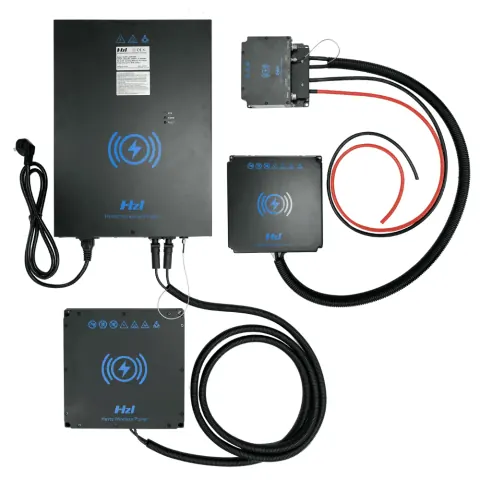
ONEPOINTECH · 3 kW · 42–58 V
LS300-A60
Dock charging for 48 V-class AGVs and AMRs. CAN/RS485, a 20–45 mm air gap and 60 A output, with voltage, coil and housing customization.
Delta Electronics · 3.3 kW · 24/36/48 V
MOOVair 03
A 3.3 kW point charger with native CANopen and Ethernet, IP65 and fanless operation. Sold through Delta's distribution network, usually as a configured project.
- 132 A at 24 V, 88 A at 36 V, 66 A at 48 V
- 10–30 mm air gap
- CE, UL, FCC
Specifications from Delta's public product material, checked November 2026.
| Parameter | Delta MOOVair 03 | ONEPOINTECH LS300-A60 |
|---|---|---|
| Continuous power | 3.3 kW | 3 kW |
| Battery voltage | 24 / 36 / 48 V | 42–58 V (58 V rated) |
| Maximum charging current | 132 A at 24 V; 88 A at 36 V; 66 A at 48 V | 60 A (10–60 A) |
| Air gap | 10–30 mm | 20–45 mm; best at 40 mm |
| Efficiency | >92%; up to 93–95% quoted | 90% max |
| Communication | CANopen (vehicle), Ethernet (infrastructure), pad-to-pad link | CAN/RS485, 2.4 GHz transmitter–receiver link |
| Protection | IP65, fanless | IP20 controller; IP65/IP54 options |
| Certification (published) | CE, UL, FCC | UL 1564, CSA, CE (RED), FCC Part 15/18 |
Delta figures: MOOVair 03 product page and 3.3 kW flyer, checked November 2026. ONEPOINTECH figures: LS300-A60 datasheet. Efficiency and air-gap values are manufacturer-stated under different conditions.
Delta MOOVair 01 vs ONEPOINTECH LC180-A30
For smaller AMRs, the 1 kW MOOVair 01 competes with the 1.5 kW LC180-A30. The LC180 has the wider voltage window, which matters if the same charger platform has to cover 24 V, 36 V and 48 V vehicles.
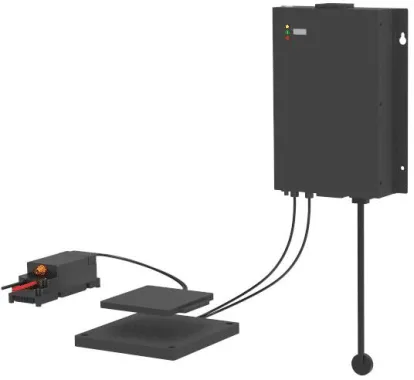
ONEPOINTECH · 1.5 kW · 18–60 V
LC180-A30
One charger platform for 24 V, 36 V and 48 V vehicles. 30 A output, a 10–30 mm air gap and CAN/RS485, available for evaluation through the shop.
Delta Electronics · 1 kW · 24/36/48 V
MOOVair 01
The compact member of the MOOVair family, for small AMRs and light vehicles. CAN and Ethernet, IP65, around 93% efficiency.
- 24 / 36 / 48 V configurations
- ~20 mm air gap
- IP65, fanless
Specifications from Delta's public product material, checked November 2026.
| Parameter | Delta MOOVair 01 | ONEPOINTECH LC180-A30 |
|---|---|---|
| Continuous power | 1 kW | 1.5 kW |
| Battery voltage | 24 / 36 / 48 V | 18–60 V |
| Maximum charging current | Per 24/36/48 V configuration | 30 A (0–30 A) |
| Air gap | ~20 mm | 10–30 mm |
| Efficiency | ~93% | >80% |
| Communication | CAN, Ethernet | CAN/RS485, 2.4 GHz link, LAN option |
| Protection | IP65 | IP20 controller; IP65/IP54 options |
Delta figures: MOOVair 01 product page, checked November 2026. ONEPOINTECH figures: LC180-A30 datasheet.
Where Delta is the right choice
- Very large fleets and 10–30 kW vehicles. ONEPOINTECH tops out at 6 kW; Delta's family goes far beyond that.
- Global distribution and local service. Delta's footprint is broader than a direct OEM supplier's.
- CANopen and Ethernet end to end. If the fleet controller already speaks CANopen and the infrastructure is Ethernet-based, Delta's native interfaces reduce integration work.
- Fanless IP65 point charging in harsh or cold environments. MOOVair is designed around that envelope.
- A vendor already approved by the end customer. In many projects the supplier list is fixed before the engineering comparison starts.
Where ONEPOINTECH fits
- 24 V, 36 V and 48 V vehicles from one platform. The LC180-A30 covers 18–60 V, which simplifies a mixed fleet.
- 6 kW above the 3.3 kW MOOVair class. The LC600-A100 covers heavier AGVs and shorter charging windows.
- Custom voltage, current, coil, housing or communication. Useful when the vehicle geometry does not match a catalogue unit.
- Sample and pilot supply. Test the coil and air gap on a real vehicle before committing to a fleet.
- Direct engineering contact and published specifications. Faster early-stage comparison than a distributor-led process.
What to check before switching
- Voltage window. LS300-A60 is a 42–58 V system, not a 24 V or 36 V charger. Match the vehicle before comparing power figures.
- Fieldbus. Delta uses CANopen; ONEPOINTECH standardises on CAN/RS485. If CANopen is mandatory, confirm it as a customization rather than assuming it.
- Coil geometry and mounting. Power and gap figures only transfer if the coil fits the vehicle's underside or rear.
- Battery BMS communication. Confirm the charge profile and the signals the BMS expects.
- Certification market. Check the exact model's UL/CSA, CE and FCC status for the country of installation.
Applications
ONEPOINTECH point-charging systems are used for AMRs, AGVs, automated guided carts, unmanned forklifts, medical carts, inspection robots and custom battery-powered equipment. The AGV and AMR wireless charging page covers the full range, and the supplier comparison puts Delta, Wiferion, VAHLE, Conductix-Wampfler and SEW-EURODRIVE in one view.
Compare another supplier
The same head-to-head is written out for Wiferion, VAHLE and Conductix-Wampfler. If you are still building the shortlist rather than comparing one supplier, the industrial wireless charging supplier comparison covers all of them in one table, together with the criteria that decide between them.
Request a Quote
Send the vehicle details and we will confirm whether a standard system fits or whether the project needs a custom configuration:
- Robot or vehicle type and fleet size
- Battery chemistry, voltage and capacity
- Required charging time and duty cycle
- Installation space, air gap and alignment tolerance
- Fieldbus requirement (CAN, CANopen, RS485 or other)
- Target certification market
- Estimated order quantity