
VAHLE is one of the oldest names in mobile electrification, and its wireless business is built around a different question from most charger suppliers. Rather than asking "how do I charge this vehicle at a dock", VAHLE's vPOWER systems ask "how do I keep this vehicle powered the whole time it moves".
That is an architecture decision, not a brand preference, and it comes before any spec table. This page sets out when continuous contactless supply is the right answer and when point charging is — and where ONEPOINTECH's two product lines, WidTrans CPS and the LC/LS dock systems, sit in each.
Two architectures, two different problems
Continuous supply: VAHLE vPOWER
A primary conductor is installed along the vehicle's route — in the floor, along a wall, or overhead — and a pickup on the vehicle draws power continuously. VAHLE builds this in two families:
- CPS 140 kHz. Compact SiC-based modules, 10 kW per module and stackable to roughly 40 kW per segment, up to about 30 kW per section. Pickups range from roughly 70 W to 4 kW. The 140 kHz band and compact hardware make it suitable for cleanroom and tight-clearance installations, with SEMI S2/S23 certification available.
- CPS 20 kHz. Higher power, up to about 40 kW per controller and 90 kW per line, with pickups up to 22 kW. Built for heavy AGVs, monorail systems, cranes and transfer cars.
VAHLE also supplies one of the widest conductive charging-contact ranges in the industry — drive-on and drive-over contacts — which matters if the project is a hybrid of inductive and contact charging.
Point charging: ONEPOINTECH LC and LS systems
ONEPOINTECH installs a transmitter at a dock, buffer position or parking bay. The vehicle drives over it, stops, and charges through the air gap. The product range runs from 60–800 W modules for OEM integration to the 1.5 kW LC180-A30, 3 kW LS300-A60 and 6 kW LC600-A100 complete systems.
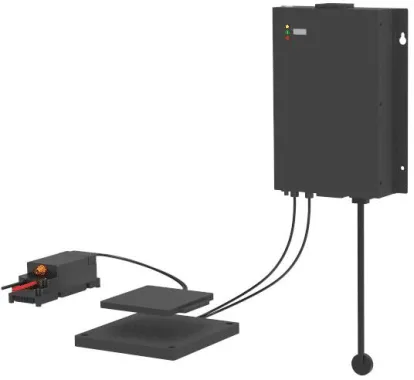
1.5 kW · 18–60 V
LC180-A30
Covers 24 V, 36 V and 48 V vehicles from one platform, at 30 A and a 10–30 mm gap.
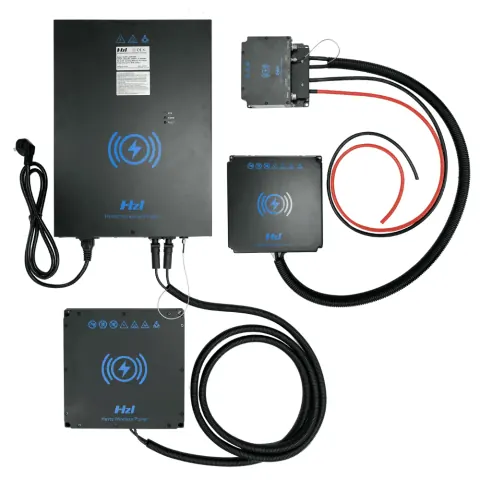
3 kW · 42–58 V
LS300-A60
48 V-class dock charging with CAN/RS485 and a 20–45 mm air gap.
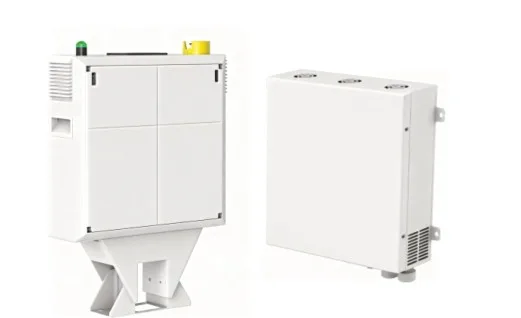
6 kW · heavier AGVs
LC600-A100
For shorter charging windows and heavier vehicles, quoted per project.
Continuous supply: ONEPOINTECH WidTrans CPS
Continuous contactless power is also in the ONEPOINTECH range, under the WidTrans name. These are track-based systems — a conductor cable fed by a power supply unit, with pickups on the moving equipment — built for overhead transport, stocker cranes and conveying rather than for floor-running AGVs.
The F140 line runs at 140 kHz and powers RGVs, sorters and linear conveyors. F10 and F20 are the cleanroom systems: F10 for OHT and overhead hoist transport, F20 for stocker cranes in wafer and LCD fabs. Where a project needs power while moving in a cleanroom, this is the ONEPOINTECH product to compare with VAHLE CPS, not the LC or LS dock chargers.
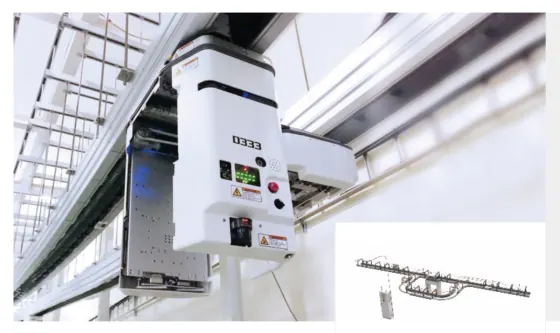
Continuous CPS · OHT / OHS
WidTrans-F10
Wear-free continuous power for semiconductor overhead transport. Zero dust, no sparks, no contact shoes to replace.
Continuous CPS · STK / OHCV
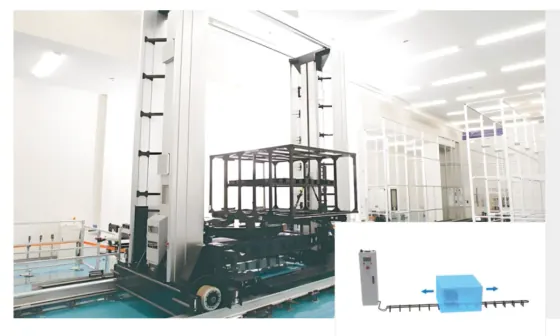
WidTrans-F20
For stocker cranes in wafer and LCD fabs. Non-contact operation, so no particle generation and no contact wear.
Continuous CPS · 140 kHz
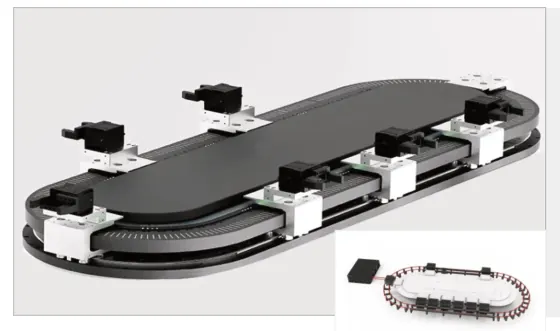
WidTrans-F140
Track cable, clamps, capacitor boxes and pickups for RGVs, sorters and linear conveyors. No speed limitation.
How to decide between them
| Question | Points toward continuous supply | Points toward point charging |
|---|---|---|
| Route shape | Fixed, long, rarely reconfigured | Short, shared, or likely to change |
| Utilisation | Near-continuous operation, 24/7 | Shift work with natural idle periods |
| Battery | Battery can shrink or be removed entirely | Battery stays; charging tops it up |
| Installation | Route must be prepared; high upfront cost | Only the dock needs equipment |
| Fleet size | Large fleets amortise the route cost | Small fleets avoid the infrastructure cost |
| Flexibility | Change is expensive | Add or move a dock cheaply |
| Vehicle weight | Lower, because the battery is smaller | Higher, because the battery is carried |
VAHLE specifications: vPOWER CPS 140 kHz and CPS 20 kHz catalogue and LogiMAT material, checked November 2026. ONEPOINTECH: product datasheets. Power figures are per module, segment or line and are not directly comparable across architectures.
The 140 kHz connection
One detail engineers notice: the LC180-A30 and the VAHLE CPS 140 kHz family both operate at 140 kHz. The systems are architecturally different — one charges at a dock, the other along a route — but the operating frequency is the same.
That makes the two worth comparing on coupling behaviour, shielding, foreign-object detection and EMI limits, because the radiated characteristics of a 140 kHz system are governed by the same standards regardless of whether the coil is in a dock or under a moving vehicle. If your EMC assessment already assumes a 140 kHz system, the LC180-A30 sits in the same regulatory frame.
Where VAHLE is the right choice
- The battery should disappear. On a fixed, high-utilisation route, removing the battery simplifies the vehicle, cuts weight and removes a maintenance item. That is the core case for continuous supply and no point charger solves it.
- Cleanroom overhead transport. The CPS 140 kHz family with SEMI S2/S23 certification is built for that environment.
- Heavy vehicles and high power. CPS 20 kHz reaches 90 kW per line; ONEPOINTECH tops out at 6 kW.
- Contacts are part of the design. If the project mixes drive-on contacts with inductive charging, VAHLE supplies both from one vendor.
- Monorail, crane and transfer-car systems. VAHLE's mobile electrification heritage is strongest in exactly these applications.
Where ONEPOINTECH fits
- The vehicle can stop to charge. Opportunity charging during natural idle time is usually cheaper than powering the whole route.
- The layout may change. Adding or moving a dock costs a fraction of reworking a conductor route.
- Small and mid-size fleets. Below the fleet size that justifies route-long infrastructure, point charging is the more economical architecture.
- Custom integration. ONEPOINTECH adapts voltage, current, coil geometry, housing and communication per project, and supplies samples before a production order.
- Published specifications. The standard range is documented publicly, which speeds up early engineering comparison.
- The route is overhead or conveyor-based. WidTrans F10/F20/F140 supply continuous power to OHT, stocker and RGV systems where the vehicle never stops to charge.
Common specification mistakes
- Comparing kW per module with kW per route. A 10 kW VAHLE module and a 6 kW ONEPOINTECH system describe different things. Compare energy delivered per shift, not nameplate power.
- Assuming continuous supply removes the battery. It can, but only if the route covers every position the vehicle occupies — including the parts it must traverse without power.
- Ignoring installation cost. Route preparation often exceeds the cost of the charging hardware itself, and it is rarely quoted in the same line.
- Overlooking the air gap and alignment. A point charger needs the vehicle to dock reliably; tolerance is the first thing to check against the vehicle's positioning accuracy.
Applications
ONEPOINTECH point charging serves AMRs, AGVs, automated guided carts, unmanned forklifts, medical carts, inspection robots and custom battery-powered equipment. For a broader view of the category, the supplier comparison puts VAHLE, Conductix-Wampfler, Wiferion, Delta and SEW-EURODRIVE in one table, and the AGV and AMR wireless charging page covers the range in detail.
Compare another supplier
The same head-to-head is written out for Wiferion, Delta MOOVair and Conductix-Wampfler. If you are still building the shortlist rather than comparing one supplier, the industrial wireless charging supplier comparison covers all of them in one table, together with the criteria that decide between them.
Request a Quote
If your vehicle can stop to charge, send the details and ONEPOINTECH will confirm the fit:
- Vehicle type, route and fleet size
- Battery chemistry, voltage and capacity
- Idle time available for opportunity charging
- Installation space, air gap and alignment tolerance
- Communication requirement (CAN, RS485 or other)
- Target certification market
- Estimated order quantity