
A forklift charging station is a designated area where an electric forklift battery receives power from a compatible charger. A complete installation includes the charger, electrical supply, parking or battery handling space, and safety provisions appropriate to the battery and facility.
For warehouse managers and automation integrators, the key decision is how to replenish enough energy within the time trucks can stop. This guide compares wired charging, battery swapping and wireless charging, explains station requirements, and shows how to evaluate ONEPOINTECH systems against your battery and shift pattern.
Planning a wireless installation? Request a forklift charging compatibility review. Share your truck model, battery voltage and capacity, fleet size, and available charging windows.
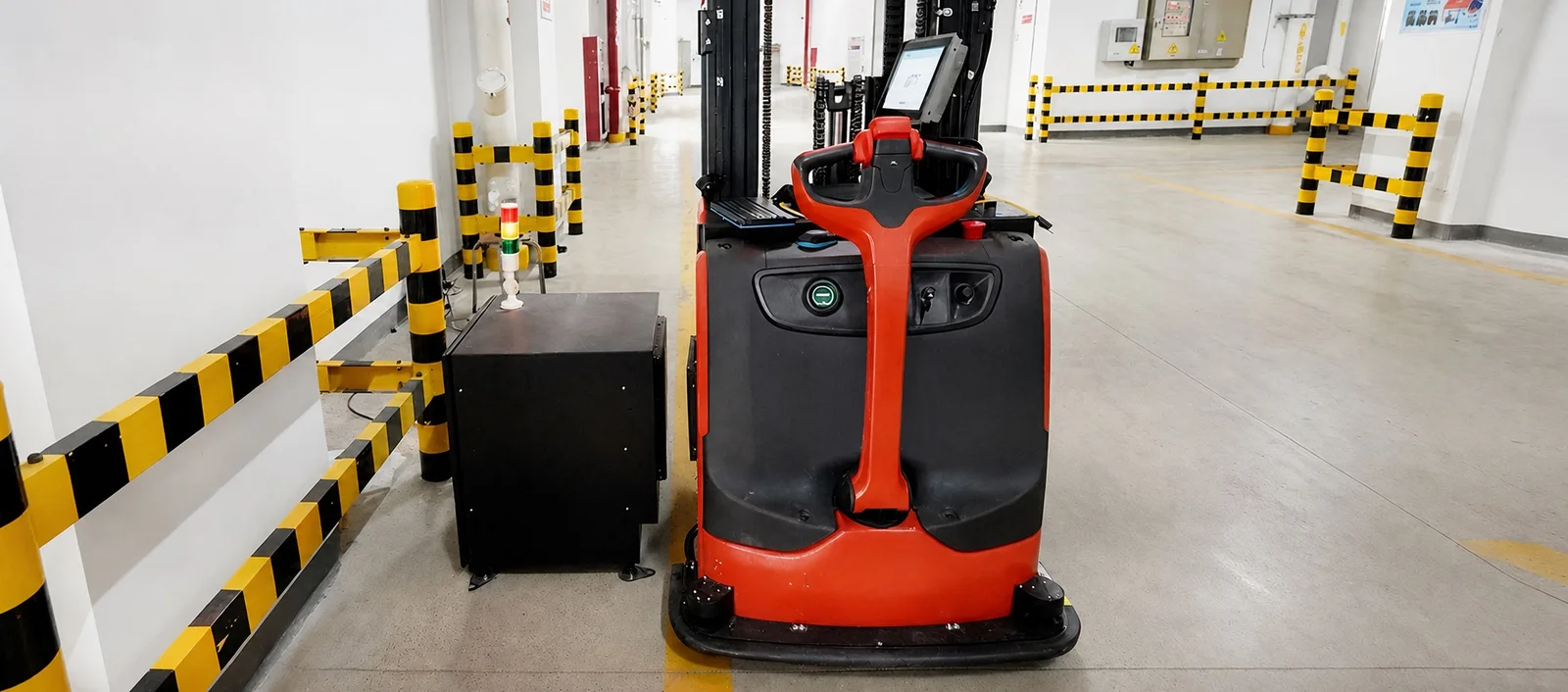
Which forklift charging setup fits your operation?
Choose the charging method around battery compatibility, energy use and available downtime. Wired charging can suit scheduled breaks or overnight stops. Battery swapping can support operations that cannot wait for onboard charging. Wireless charging is worth evaluating where trucks park repeatedly and automatic charging reduces manual intervention.
| Setup | When to consider it | What to account for |
|---|---|---|
| Wired battery charging | Trucks have accessible charging positions and operators can connect a cable | Connector handling, cable routing, charger compatibility and available charge time |
| Battery swapping | A compatible spare battery can keep a truck working during recharge | Spare packs, handling equipment, storage space and trained operators |
| Wireless charging | Automated or manually driven trucks return to repeatable parking positions | A receiver on each truck, transmitter locations, alignment and control integration |
Opportunity charging is a schedule, not a separate connector technology. It means topping up during breaks or other stops, using a battery-approved wired or wireless charger. For a battery-specific example, the EnerSys NexSys TPPL with Accelerated Throughput Package (ATP) owner’s manual (PDF) describes charging during operator breaks and shift changes, and requires an EnerSys-approved charger for that battery. Wireless equipment automates the connection step; the energy balance still determines whether the schedule works.
What are the requirements for a forklift charging station?
The station needs a compatible charger, an adequate electrical supply, protected equipment and a layout that supports safe vehicle movement. Battery chemistry and local requirements determine additional provisions.
Designated charging areas and ventilation
For US workplaces, OSHA 29 CFR 1910.178(g) requires designated battery charging areas. It includes provisions for electrolyte spills, fire protection, protecting charging equipment from truck damage, and ventilation to disperse fumes from gassing batteries. It also addresses smoking, ignition sources and vehicle positioning during charging.
A designated area does not automatically mean a separate enclosed battery room. Lead-acid battery gassing makes ventilation an important design issue. Moving to lithium changes the battery-specific assessment, but does not by itself establish that an existing room, ventilation arrangement or fire protection provision can be removed. Confirm the installation with the battery supplier and the authority responsible for local approval.
Electrical supply and physical layout
- Available power: verify charger input requirements, the number of stations running together, circuit protection and site capacity with the electrical designer.
- Traffic flow: position charging bays so parked trucks and equipment do not obstruct access or operating routes.
- Equipment protection: account for vehicle impact, debris, moisture and cleaning practices.
- Battery access: provide the handling and maintenance space required for the selected battery system.
A wireless pad removes the exposed charging connector, but the installation still needs supply wiring and suitable enclosures. Check the protection rating of each component; a sealed coil does not make the entire system suitable for washdown or outdoor use.
How do you size a forklift battery charger?
Size the charger from the energy the truck must recover and the time available to recover it. Then check the battery's full charging voltage range, permitted current, charging profile and communication requirements. Truck class or nominal battery voltage alone is insufficient.
A worked charging-time example
Consider a hypothetical 48V, 400Ah battery charged from 20% to 80% state of charge:
- Approximate nominal energy: 48 × 400 ÷ 1,000 = 19.2 kWh.
- Energy to replenish: 19.2 × 0.60 = 11.52 kWh.
- At an assumed average 3 kW delivered to the battery: 11.52 ÷ 3 = 3.84 hours.
This is a planning example, not a charging-time promise. Actual battery voltage changes during charging, and temperature, charge taper and battery limits affect average delivered power. When using AC input power in a calculation, include conversion losses.
Maximum power and maximum current are separate limits. At a battery terminal voltage of 48V, a 100A current limit caps output at 4.8 kW, even if the charger is rated up to 6 kW. Check the operating point and charge curve before estimating recharge time.
Can short stops supply enough energy?
At an assumed average 3 kW delivered to the battery, a 15-minute stop supplies 0.75 kWh. Eight such stops supply 6 kWh. If a truck consumes more than that over the operating period, the plan needs additional charging time, greater compatible power or another energy strategy. Allow for missed stops and queues when several trucks share a station.
Use the industrial wireless charging power calculator for an initial estimate, then validate it with measured truck consumption. Our opportunity charging guide explains the scheduling approach for automated fleets.
How does wireless forklift charging work?
A wireless forklift charging system transfers energy inductively between a stationary transmitter coil and a receiver coil mounted on the truck. The receiver delivers controlled DC power to the battery. With compatible controls and correct positioning, charging can start without an operator connecting a cable.
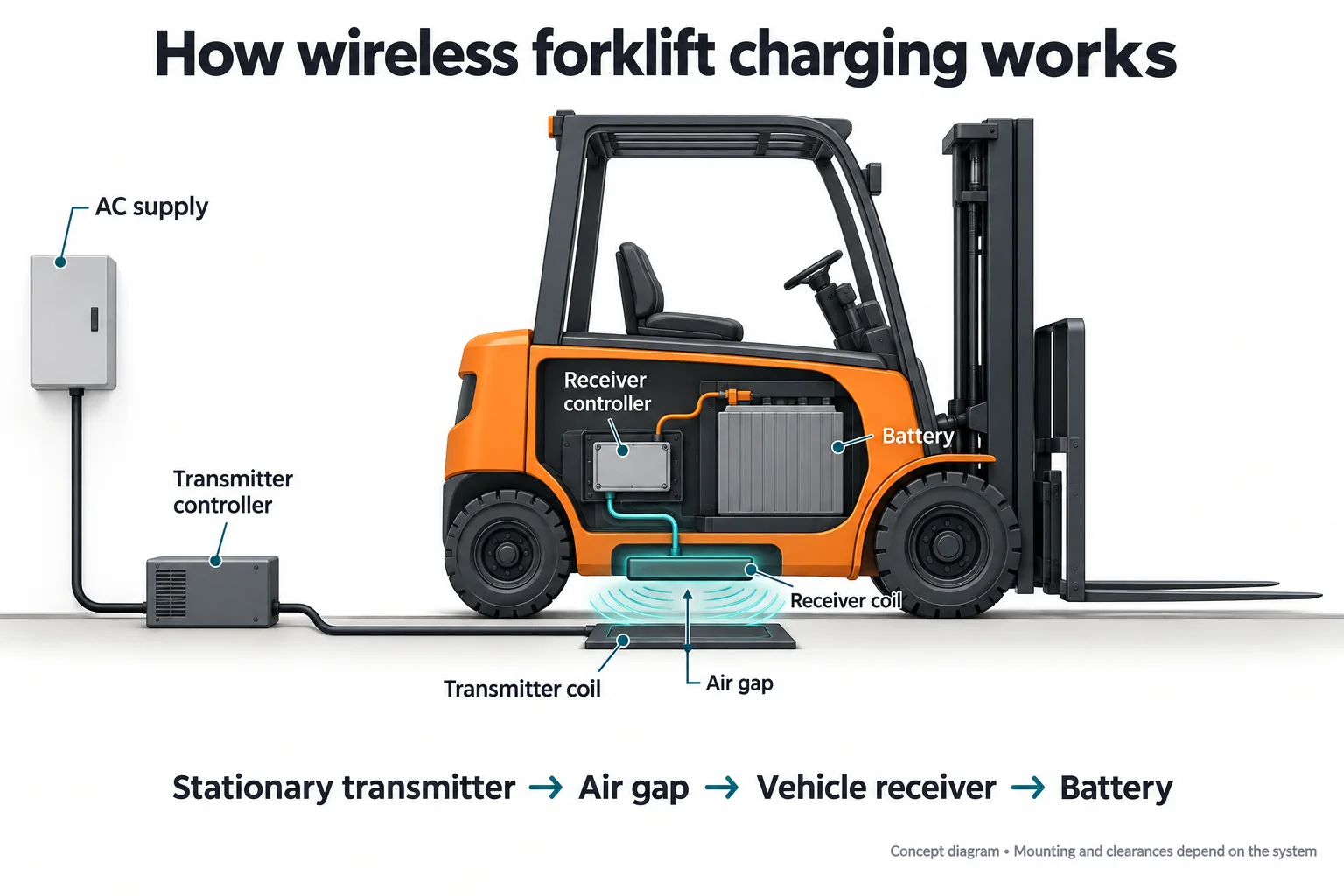
The integration includes the transmitter controller and coil, receiver coil and controller, battery connection, and charging controls. Review mounting space, loaded ground clearance, coil separation and parking accuracy on the actual vehicle. CAN or RS485 availability does not establish compatibility by itself: the messages, interlocks and battery management system (BMS) behavior must also match.
Wireless charging is a stronger candidate when trucks stop in predictable locations and those stops provide enough charging time. A one-truck pilot can establish alignment reliability, delivered energy per stop and how charging fits the operating schedule before a fleet rollout.
Compare ONEPOINTECH wireless charging systems
The systems below are candidates for compatible industrial vehicle projects. Specifications come from ONEPOINTECH's product information; final selection requires checking the complete battery charging range and vehicle integration.
| System | Maximum output power | Output voltage / maximum current | Listed coil distance |
|---|---|---|---|
| LC180-A30 | 1.5 kW | 18–60V / 30A | 10–30 mm; optimal 20 mm |
| LS300-A60 | 3 kW | 42–58V / 60A | 20–45 mm; optimal 40 mm |
| LC600-A100 | 6 kW | 15–60V / 100A | 20–40 mm |
The LC180-A30 lists support for lead-acid and several lithium-based battery chemistries, including LiFePO4. The LS300-A60 lists lithium batteries, including LiFePO4, and names unmanned forklifts among its applications. The LC600-A100 also lists unmanned forklifts; confirm the required battery profile for your configuration.
These output ranges do not support directly charging an 80V nominal forklift battery. Even for a nominal 48V pack, verify its required end-of-charge voltage against the charger maximum. For requirements beyond the listed ranges, request a custom wireless charging evaluation.
Before ordering, request the current datasheet, installation instructions and model-specific certification or conformity documents for your destination market. A list of standards on a product page does not replace review of the supplied configuration.
What determines installation cost and return on investment?
Compare total installed and operating cost over the same period. A wireless quote should identify transmitter stations, receivers for each vehicle, mounting work, electrical installation, communication integration and commissioning.
For the business case, measure current time spent connecting chargers or swapping packs, connector maintenance, spare-battery costs and charging-related downtime. Compare those costs with the proposed system's equipment, energy use and maintenance. Include only savings the operating plan or pilot supports; wireless charging does not guarantee that spare batteries or downtime disappear.
Get a charging configuration matched to your forklift
Send ONEPOINTECH the information below to request a compatibility review and an itemized quote:
- Truck and fleet: manufacturer, model, vehicle count, and manual or automated operation.
- Battery: chemistry, nominal voltage, capacity in Ah or kWh, full charging voltage range and maximum accepted current.
- Schedule: shifts per day, measured energy use if available, and the duration and location of charging stops.
- Integration: BMS protocol, receiver mounting space, ground clearance and parking accuracy.
- Site: country, available electrical supply, operating environment and required documentation.
Request a forklift wireless charging quote or email info@onepointech.com with your battery datasheet and shift pattern. Ask for the proposed system, integration scope and pilot acceptance criteria so you can assess the next step against your operation.
Still comparing technologies? Explore the AGV wireless charging systems, the broader industrial wireless charging range, and the AGV battery charging systems guide.