
Quasi Robotics announced a wireless docking option for selected Model C2 autonomous mobile robots on October 27, 2026. For teams designing AMR charging systems, the useful lesson is to specify the charging workflow alongside the power hardware: available charging time, battery limits and docking conditions determine whether a system fits the application.
ONEPOINTECH supplies wireless charging systems for automated guided vehicles (AGVs) and AMRs. In this industry-news analysis, we examine the announcement and show how integrators can turn a charging requirement into measurable selection criteria.
What the Model C2 wireless charging launch includes
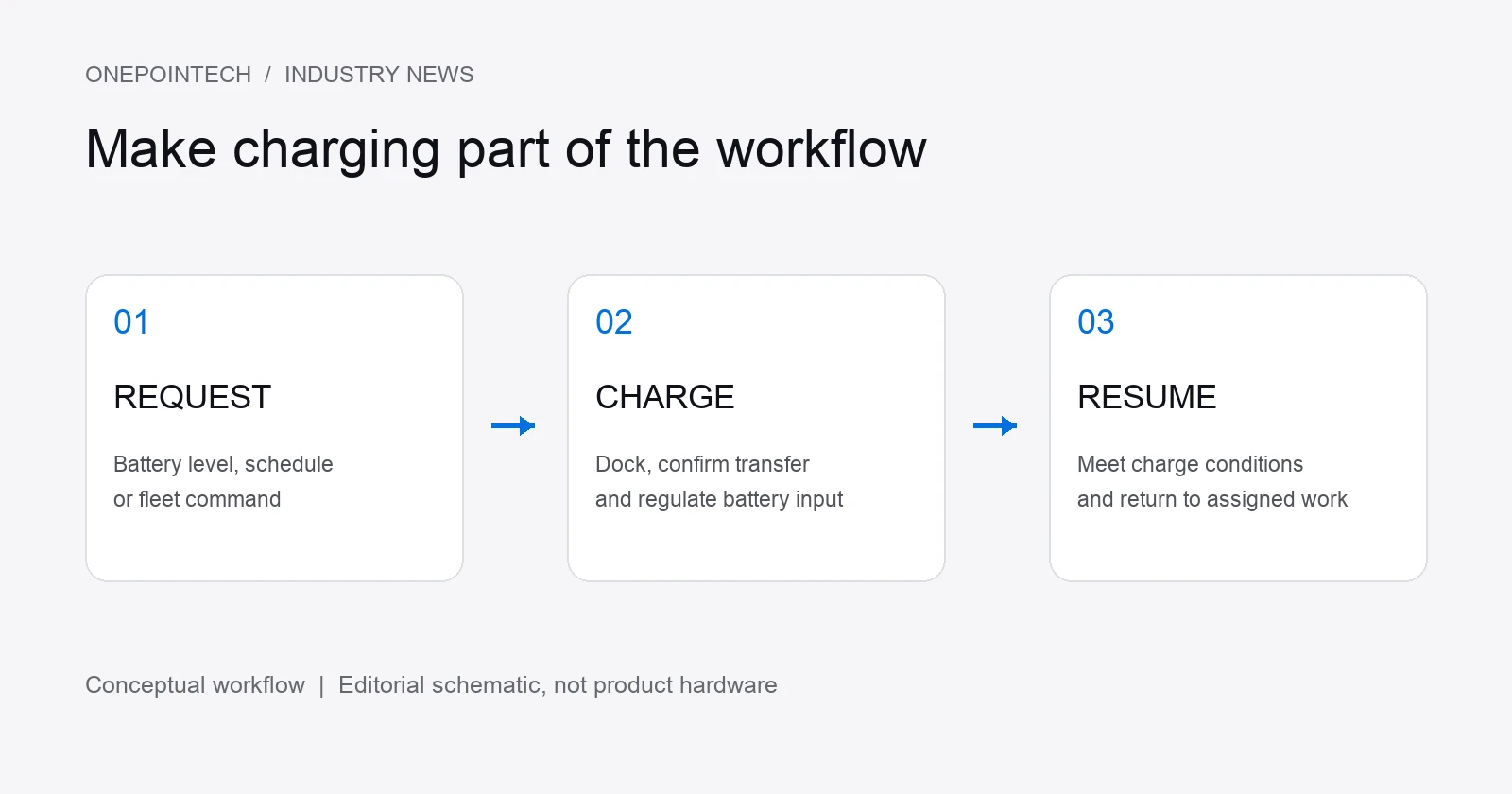
According to Quasi Robotics’ October 27 announcement, the option uses WiBotic’s 300W technology and is available for Model C2 Large, PartPorter and Heavy. Mini and Standard are excluded. Compatible robots can dock, recharge and return to assignments, with charging planned around transport demand.
The company’s wireless charging documentation lists activation by battery level, configured schedule or fleet-management command. It describes a station transmitter, a robot-mounted receiver and an onboard charger. The stated charging power is up to 300W; actual charging depends on the battery, configuration, alignment and operating conditions.
Why available charging time changes the power requirement
Average net battery replenishment power equals energy to replace divided by active charging time. Use watt-hours for energy and hours for time. Use active power-transfer time, excluding travel, docking and communication setup.
Consider an illustrative design example, unrelated to Model C2 performance: a robot needs to recover 120Wh before its next work period.
- 20 minutes of active charging: 120Wh ÷ (20/60 hours) = 360W average net battery replenishment.
- 10 minutes of active charging: 120Wh ÷ (10/60 hours) = 720W average net battery replenishment.
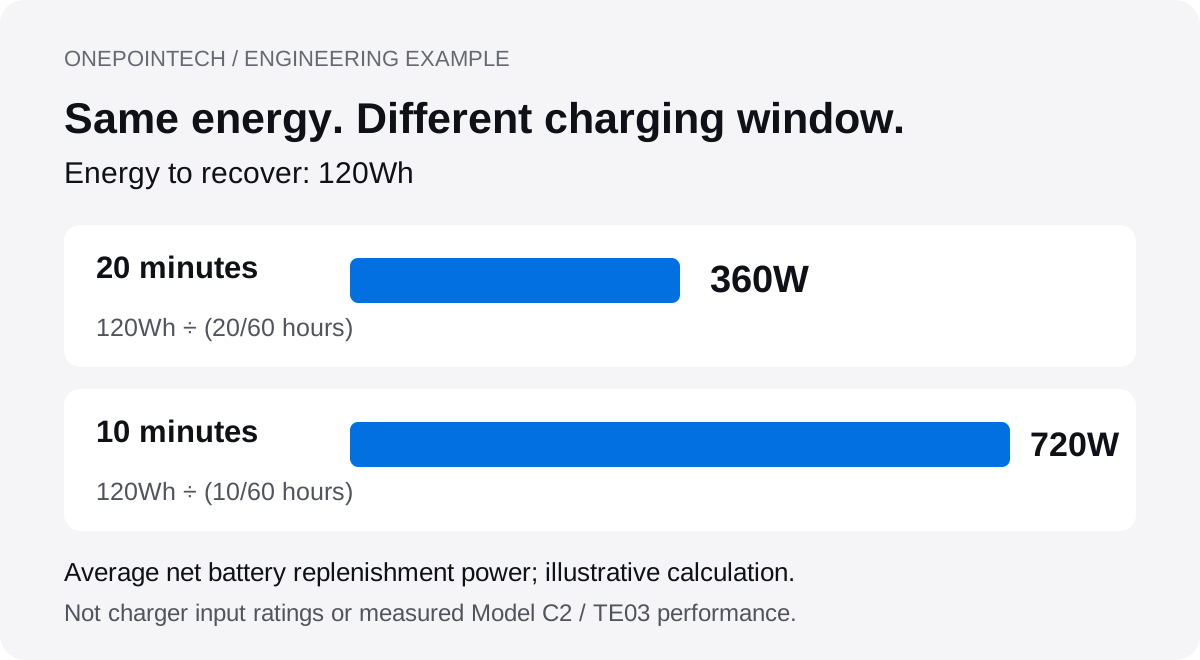
These calculated values describe net energy recovery at the battery, rather than charger input ratings. Hardware selection must also account for conversion losses, loads running during charging, battery current limits and any charge taper. If the battery cannot accept the required power, extend the charging window or revise the operating schedule.
Our AGV and AMR charging power guide develops this calculation further. The opportunity charging guide covers how to locate useful charging windows within the work cycle.
AMR wireless charging selection checklist
Use measured vehicle and site requirements to narrow the hardware options. The following table is ONEPOINTECH’s editorial framework for preparing a technical inquiry.
| Requirement | What to measure or confirm | Selection consequence |
|---|---|---|
| Route energy and charging time | Energy consumed with representative payloads; active charging minutes available per work cycle. | Establish the average net replenishment power and whether the schedule is feasible. |
| Battery and battery management system (BMS) | Chemistry, charging voltage, allowable current across temperature and state of charge, and charge-enable signals. | Select a compatible output envelope and control interface. |
| Mounting and docking | Receiver space, coil separation, parking variation and protective-cover geometry. | Choose a coil arrangement and validate transfer across the expected docking envelope. |
| Thermal and site conditions | Ambient temperature, enclosure ventilation, dust, water exposure and nearby metal. | Check component protection, cooling and sustained output in the final installation. |
| Fleet control and recovery | Charging request source, station availability, start confirmation, departure permission and fault handling. | Define the control sequence and acceptance tests before commissioning. |
For a complete inquiry outline, use the AMR charging station specification guide. Review the physical interface with the wireless charging dock design guide.
Explore the TE03 200W module for lower-power robot projects
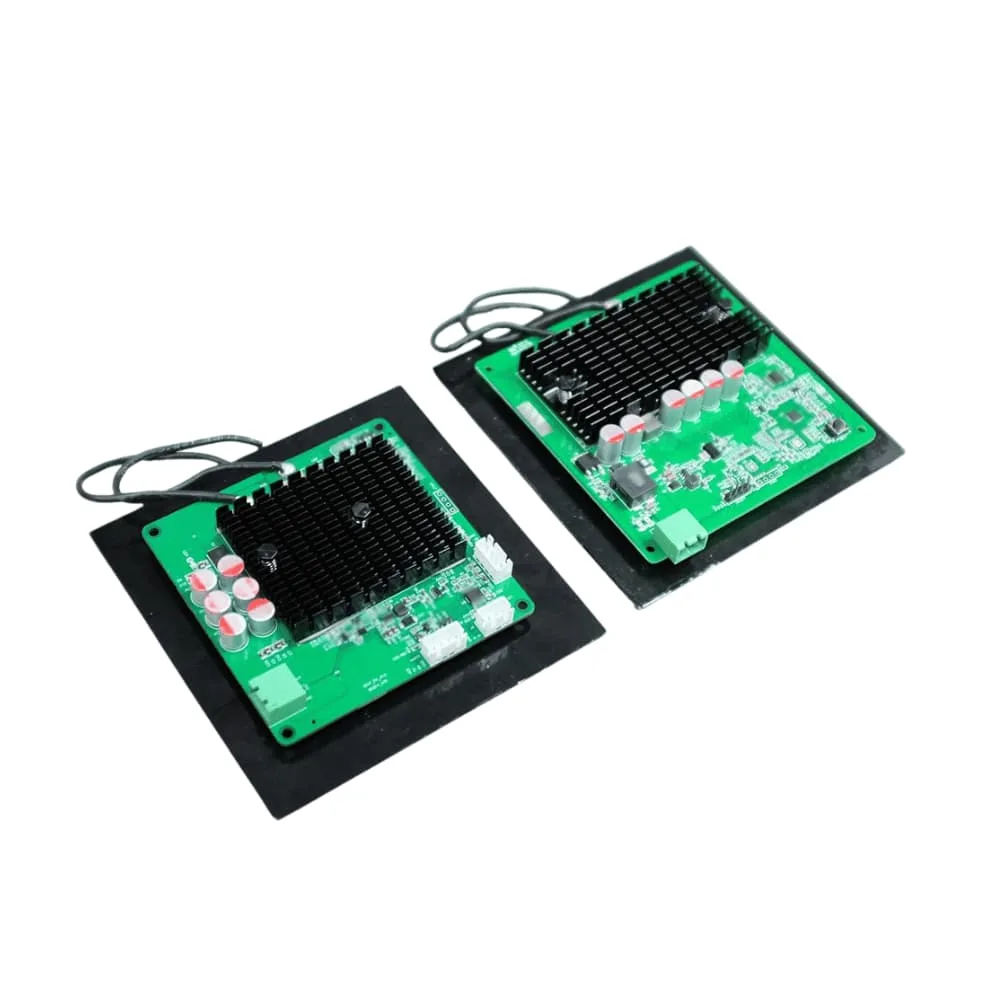
For OEM projects with a lower charging-power requirement, ONEPOINTECH offers the TE03 200W wireless charging module, a matched transmitter and receiver set. Review its TE03 product datasheet against your battery voltage, allowable charging current and mounting constraints.
The TE03 is a 200W option for projects with a smaller energy requirement or a longer charging window. It cannot meet the illustrative 360W or 720W net replenishment requirements above. Check the complete energy budget and battery compatibility before selecting a module.
Discuss TE03 integration with ONEPOINTECH: send your battery datasheet, route energy measurements, active charging window and receiver mounting drawing. If your energy budget requires more power, compare the wider AGV and AMR charging range. During commissioning, measure net energy recovered and return-to-service time against the planned work cycle.
Industry-news analysis by ONEPOINTECH, based on the linked Quasi Robotics sources. The Model C2 charging option uses WiBotic technology; the TE03 is presented for separate OEM projects, without a claim of Model C2 compatibility or partnership.